Data Management Pillar Overview

The DAMA wheel is our field's shared map of how data gets managed: governance at the hub, eleven knowledge areas around it, and where data ethics fit in. AI is not officially part of the DAMA wheel yet, and is not a recognized data management pillar. DAMA is working on where it fits. For now, I tried integrating AI concepts with existing pillars and what was left over into a new one. Here is a short, high-level tour. Flip through it below.
Slide 1: AN INTRODUCTION TO | DATA MANAGEMENT PRINCIPLES | A high-level tour of the eleven DAMA knowledge areas - plus where data ethics and AI fit
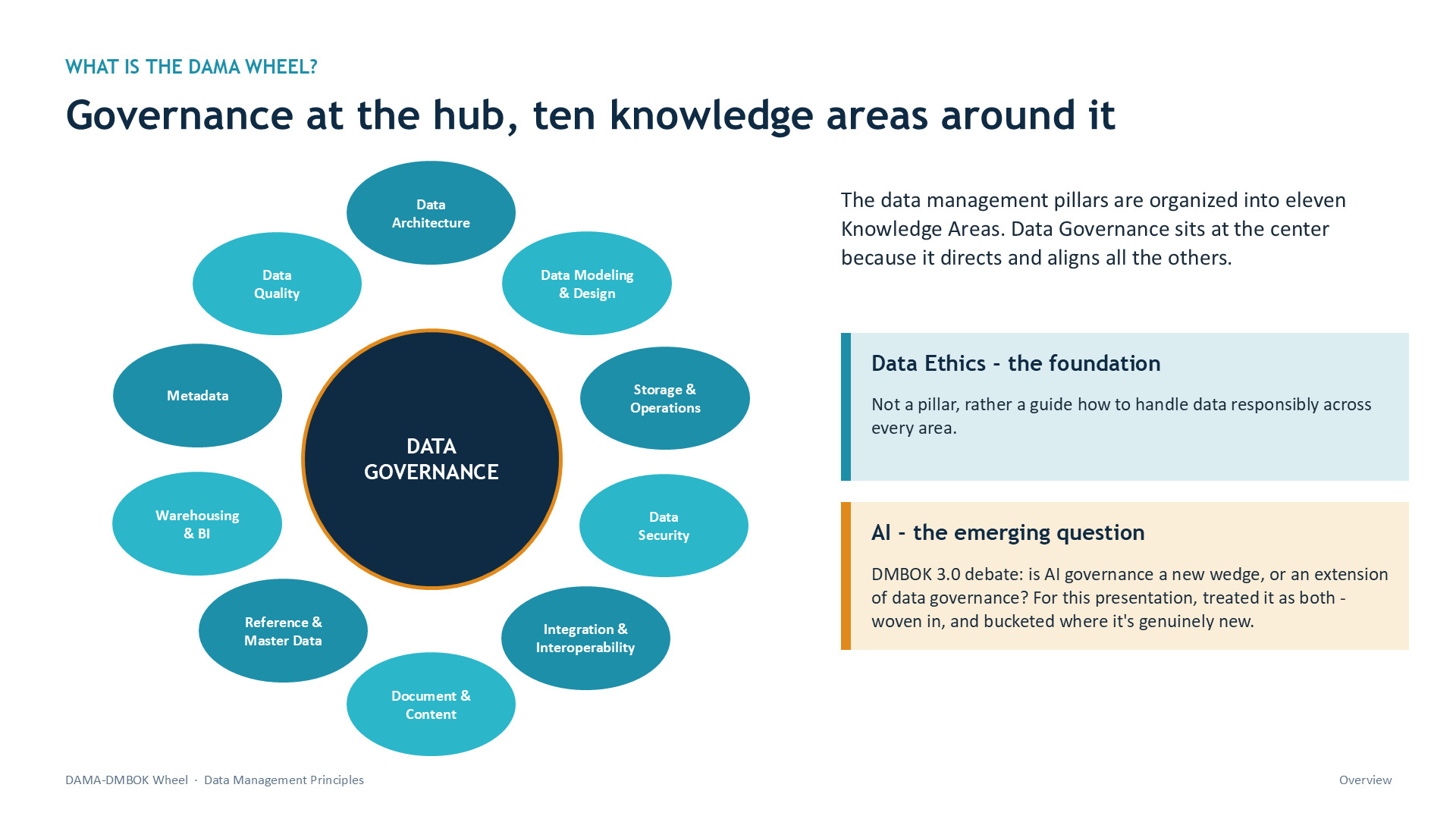
Slide 2: WHAT IS THE DAMA WHEEL? | Governance at the hub, ten knowledge areas around it | Data Architecture | Data Modeling & Design | Storage & Operations | Data Security | Integration & Interoperability | Document & Content | Reference & Master Data | Warehousing & BI | Metadata | Data Quality | DATA GOVERNANCE | The data management pillars are organized into eleven Knowledge Areas. Data Governance sits at the center because it directs and aligns all the others. | Data Ethics - the foundation | Not a pillar, rather a guide how to handle data responsibly across every area. | AI - the emerging question | DMBOK 3.0 debate: is AI governance a new wedge, or an extension of data governance? For this presentation, treated it as both - woven in, and bucketed where it's genuinely new.
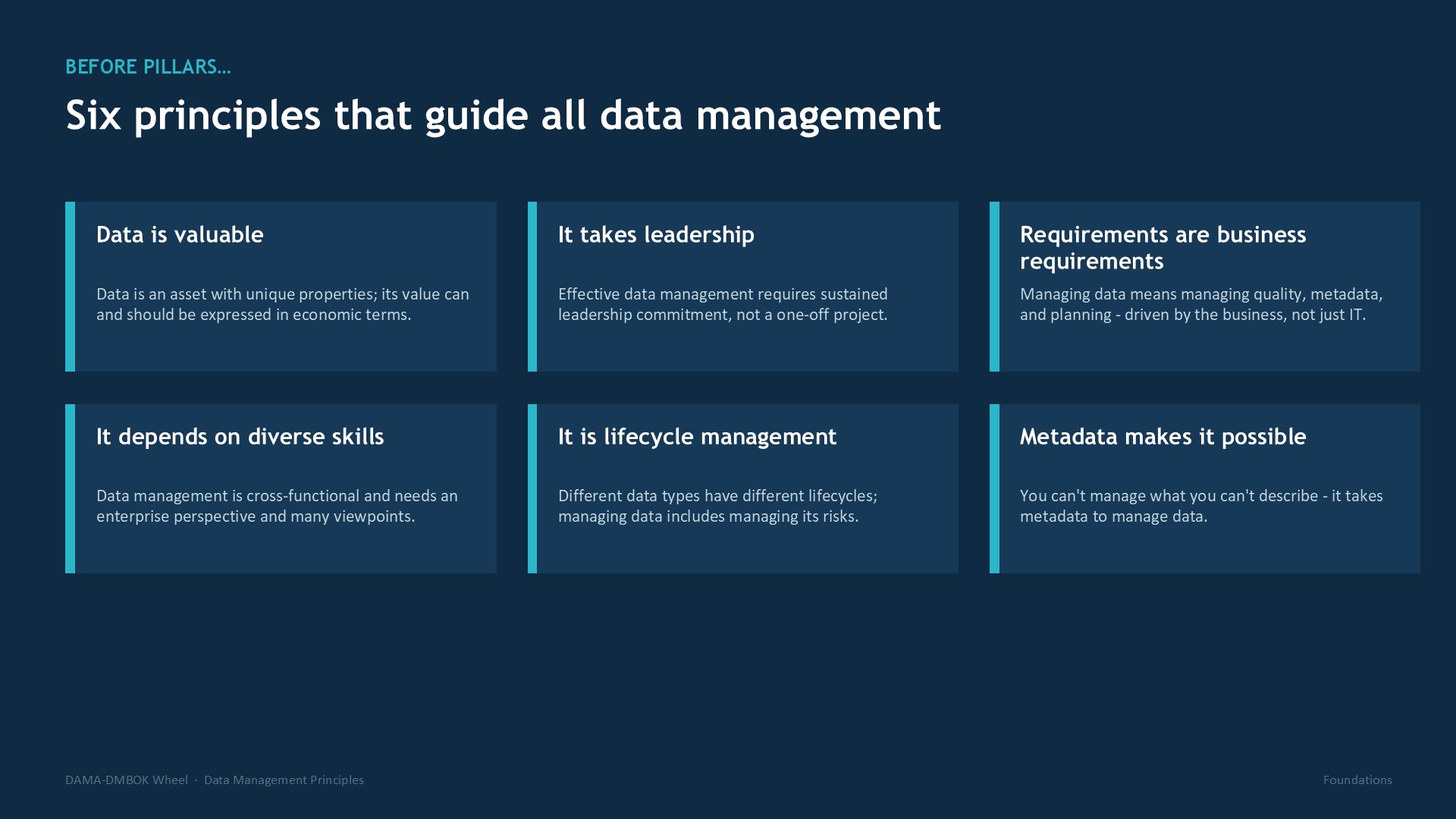
Slide 3: BEFORE PILLARS… | Six principles that guide all data management | Data is valuable | Data is an asset with unique properties; its value can and should be expressed in economic terms. | It takes leadership | Effective data management requires sustained leadership commitment, not a one-off project. | Requirements are business requirements | Managing data means managing quality, metadata, and planning - driven by the business, not just IT. | It depends on diverse skills | Data management is cross-functional and needs an enterprise perspective and many viewpoints. | It is lifecycle management | Different data types have different lifecycles; managing data includes managing its risks. | Metadata makes it possible | You can't manage what you can't describe - it takes metadata to manage data.
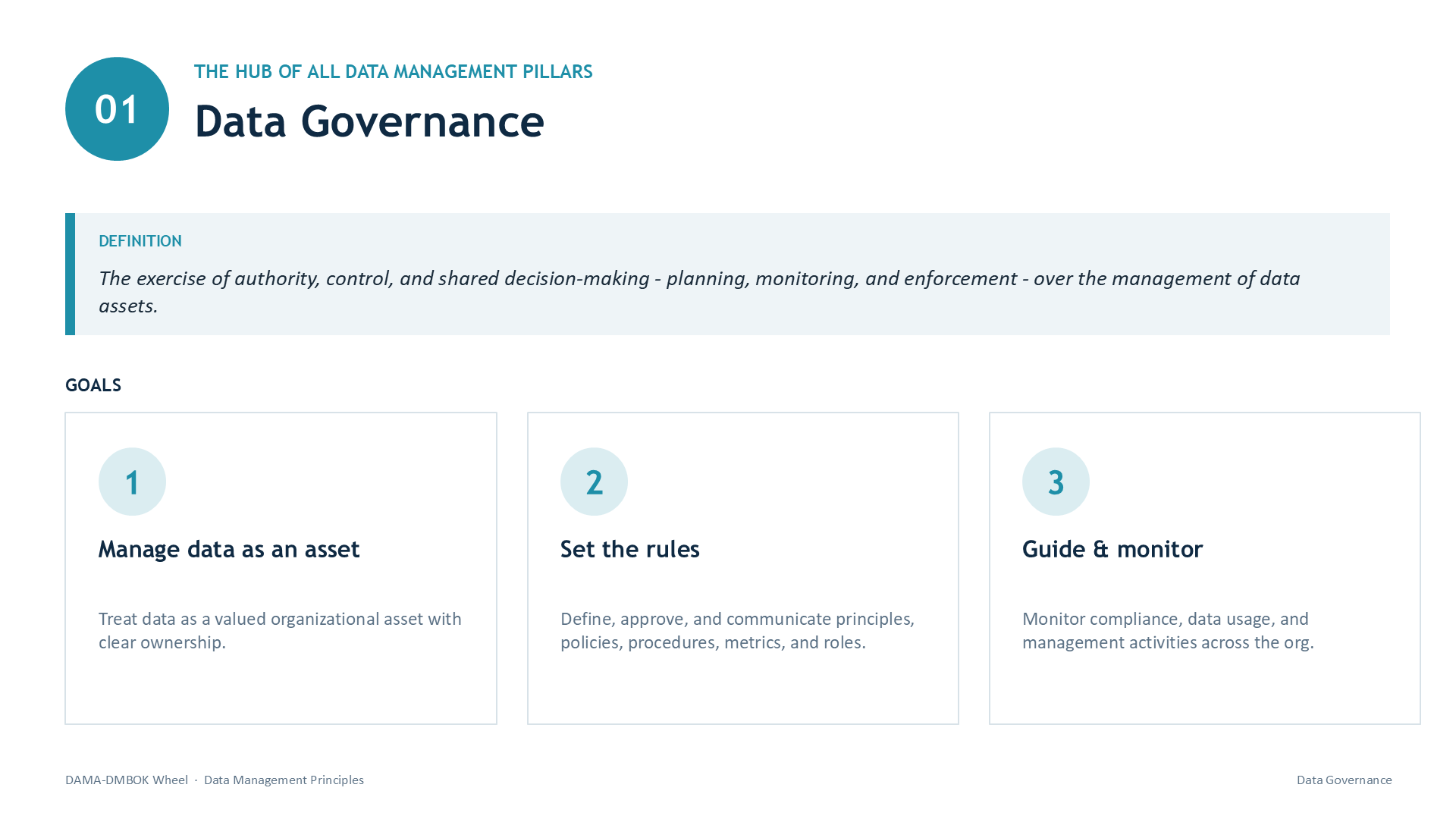
Slide 4: 01 | THE HUB OF ALL DATA MANAGEMENT PILLARS | Data Governance | DEFINITION | The exercise of authority, control, and shared decision-making - planning, monitoring, and enforcement - over the management of data assets. | GOALS | 1 | Manage data as an asset | Treat data as a valued organizational asset with clear ownership. | 2 | Set the rules | Define, approve, and communicate principles, policies, procedures, metrics, and roles. | 3 | Guide & monitor | Monitor compliance, data usage, and management activities across the org.
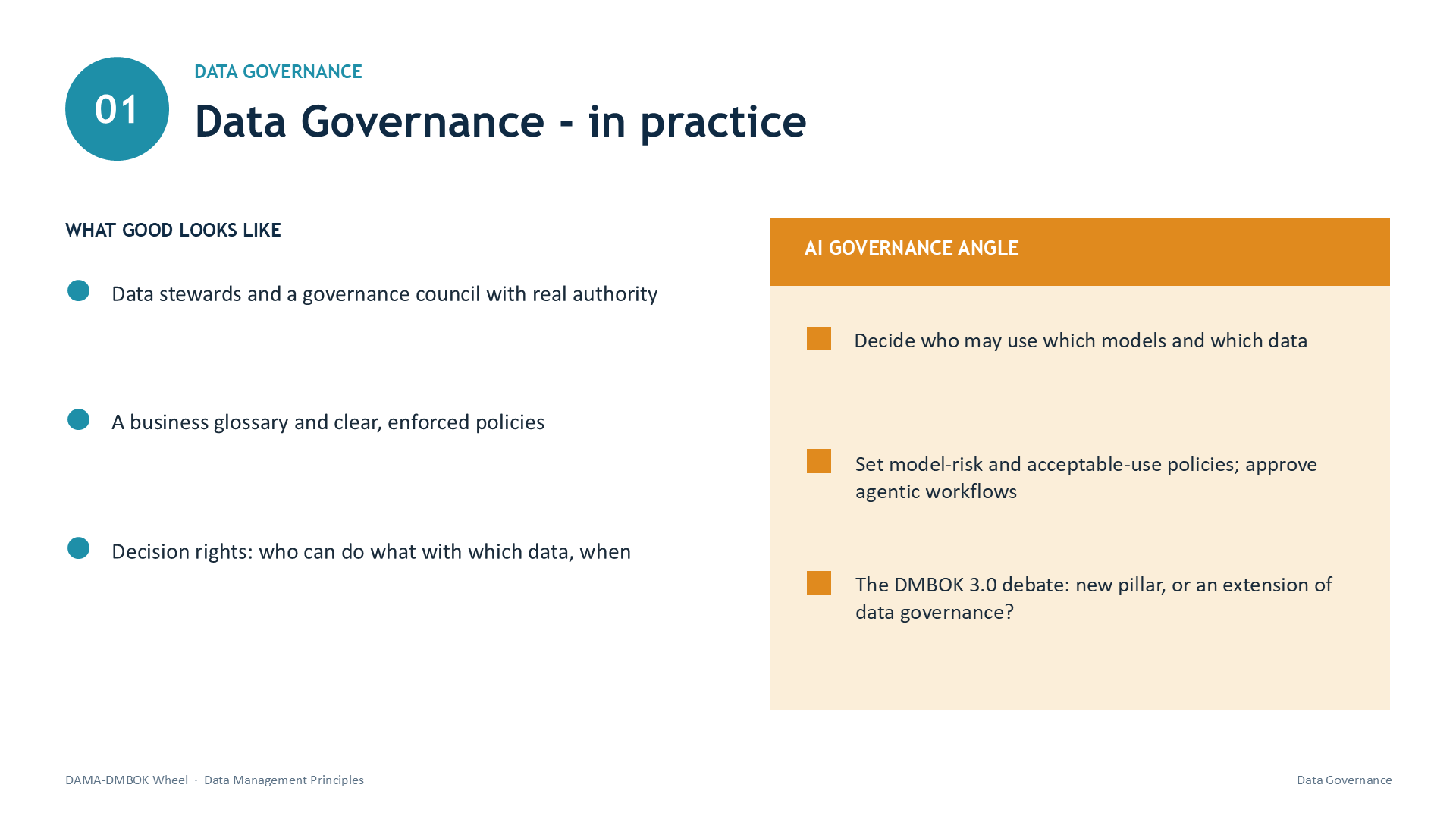
Slide 5: 01 | DATA GOVERNANCE | Data Governance - in practice | WHAT GOOD LOOKS LIKE | Data stewards and a governance council with real authority | A business glossary and clear, enforced policies | Decision rights: who can do what with which data, when | AI GOVERNANCE ANGLE | Decide who may use which models and which data | Set model-risk and acceptable-use policies; approve agentic workflows | The DMBOK 3.0 debate: new pillar, or an extension of data governance?
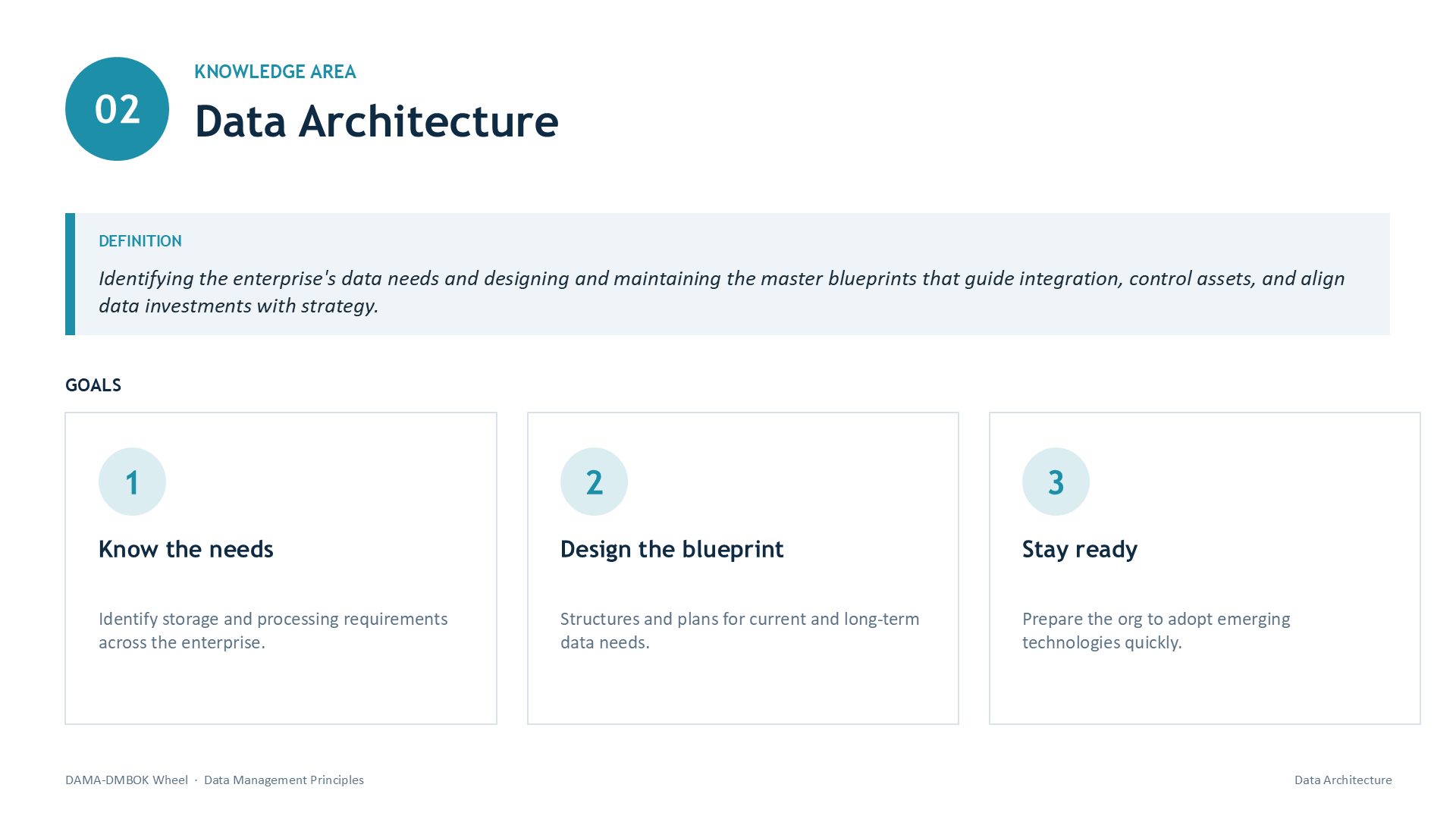
Slide 6: 02 | KNOWLEDGE AREA | Data Architecture | DEFINITION | Identifying the enterprise's data needs and designing and maintaining the master blueprints that guide integration, control assets, and align data investments with strategy. | GOALS | 1 | Know the needs | Identify storage and processing requirements across the enterprise. | 2 | Design the blueprint | Structures and plans for current and long-term data needs. | 3 | Stay ready | Prepare the org to adopt emerging technologies quickly.
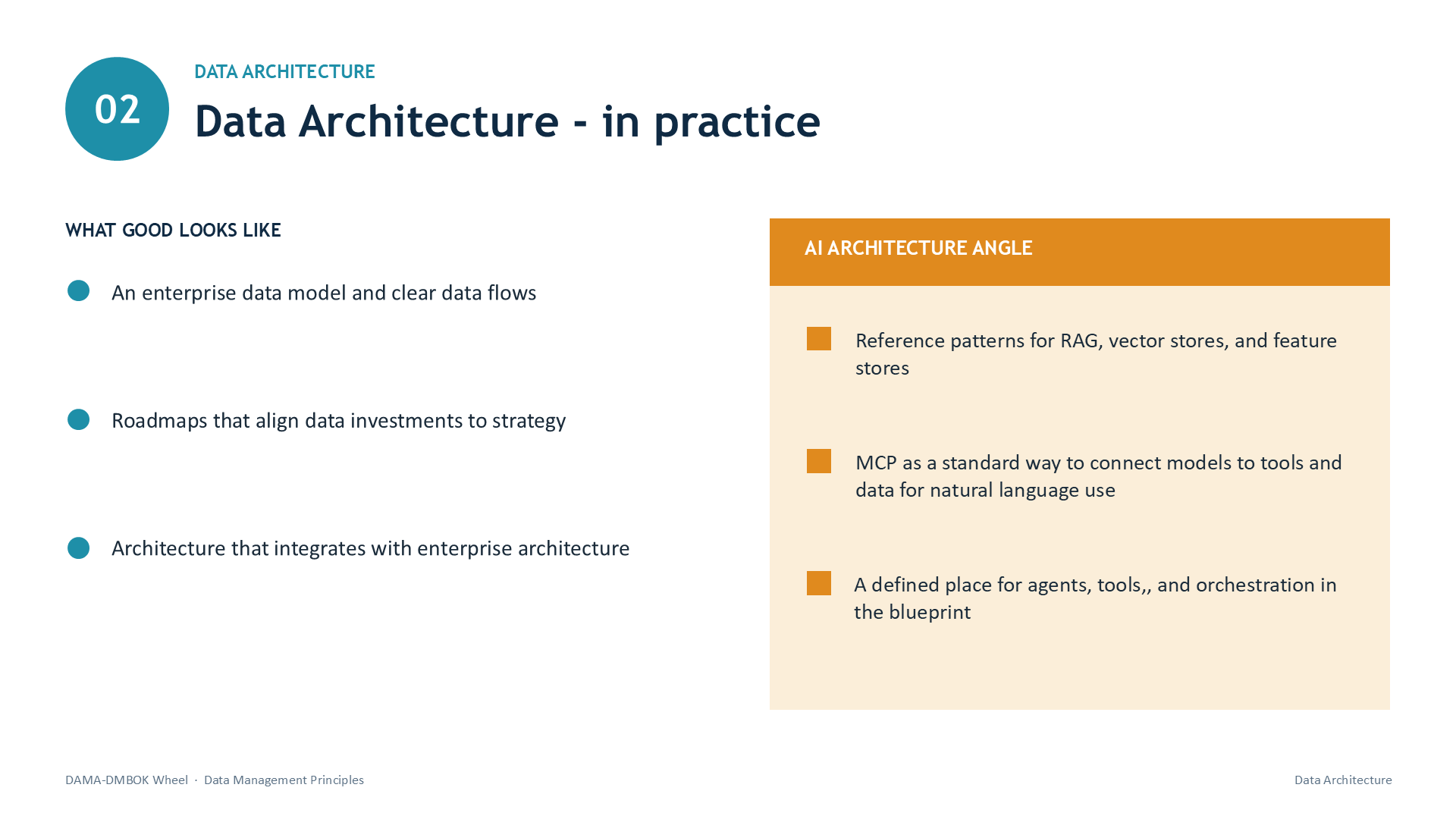
Slide 7: 02 | DATA ARCHITECTURE | Data Architecture - in practice | WHAT GOOD LOOKS LIKE | An enterprise data model and clear data flows | Roadmaps that align data investments to strategy | Architecture that integrates with enterprise architecture | AI ARCHITECTURE ANGLE | Reference patterns for RAG, vector stores, and feature stores | MCP as a standard way to connect models to tools and data for natural language use | A defined place for agents, tools, and orchestration in the blueprint
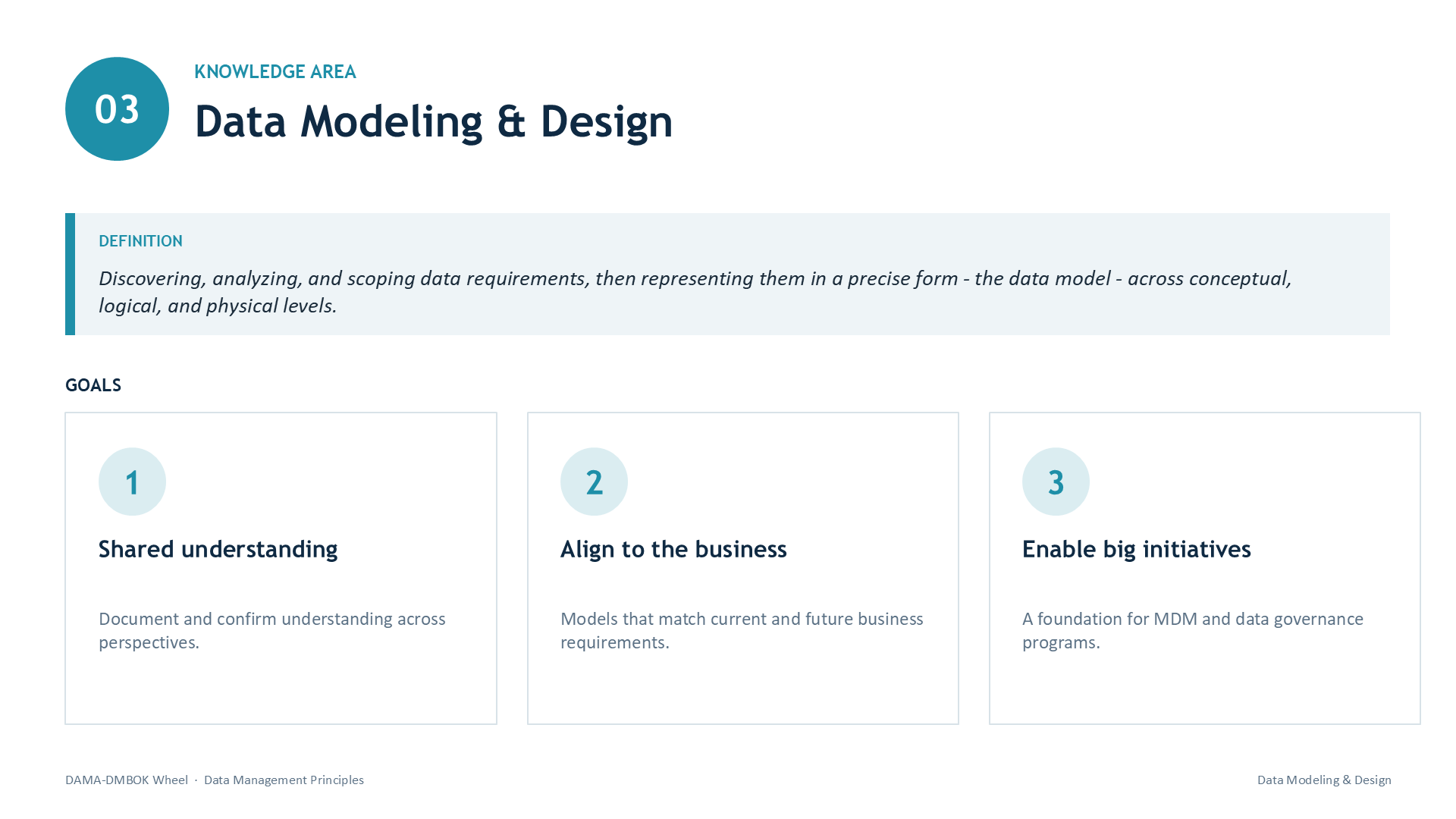
Slide 8: 03 | KNOWLEDGE AREA | Data Modeling & Design | DEFINITION | Discovering, analyzing, and scoping data requirements, then representing them in a precise form - the data model - across conceptual, logical, and physical levels. | GOALS | 1 | Shared understanding | Document and confirm understanding across perspectives. | 2 | Align to the business | Models that match current and future business requirements. | 3 | Enable big initiatives | A foundation for MDM and data governance programs.
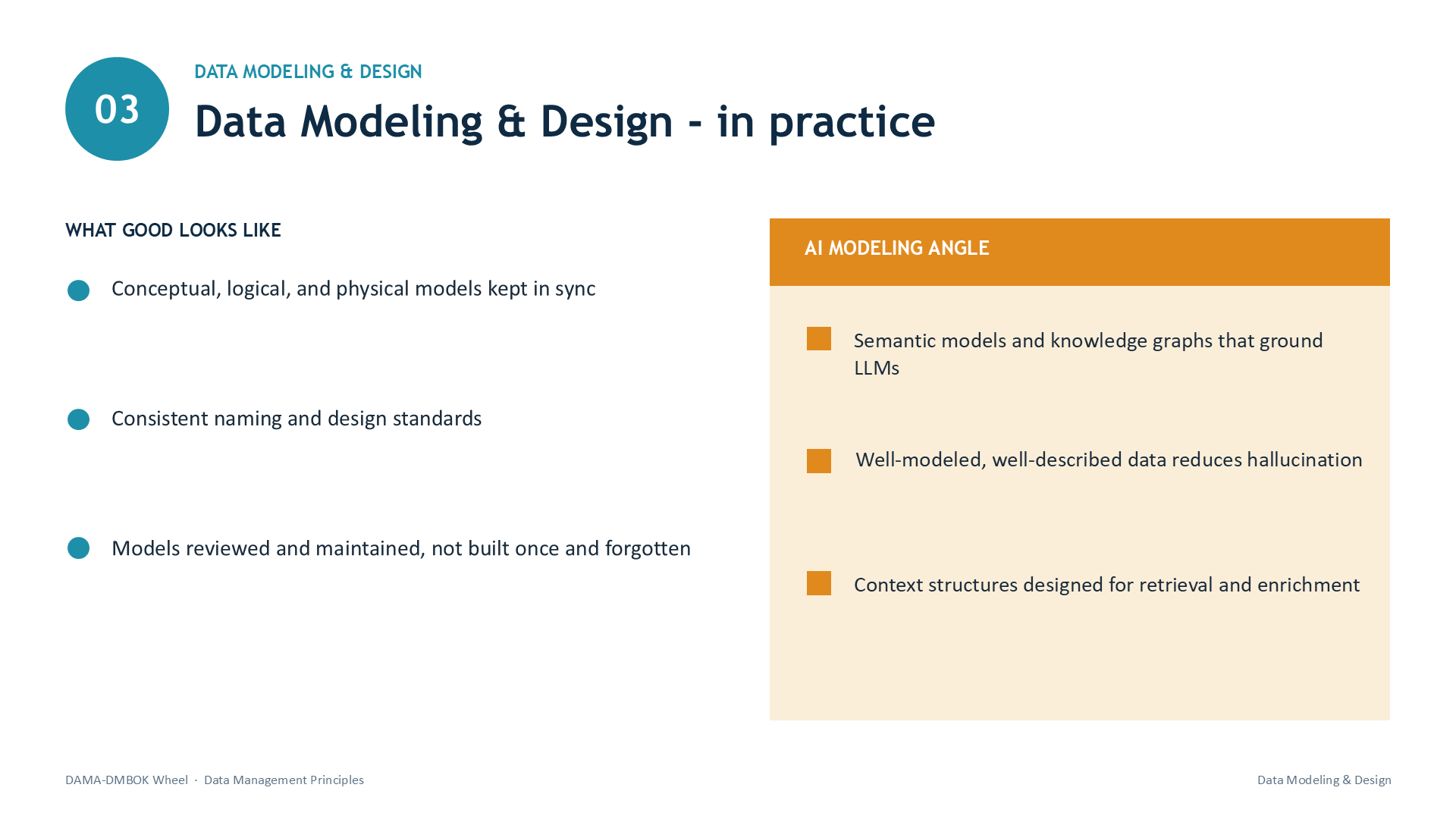
Slide 9: 03 | DATA MODELING & DESIGN | Data Modeling & Design - in practice | WHAT GOOD LOOKS LIKE | Conceptual, logical, and physical models kept in sync | Consistent naming and design standards | Models reviewed and maintained, not built once and forgotten | AI MODELING ANGLE | Semantic models and knowledge graphs that ground LLMs | Well-modeled, well-described data reduces hallucination | Context structures designed for retrieval and enrichment
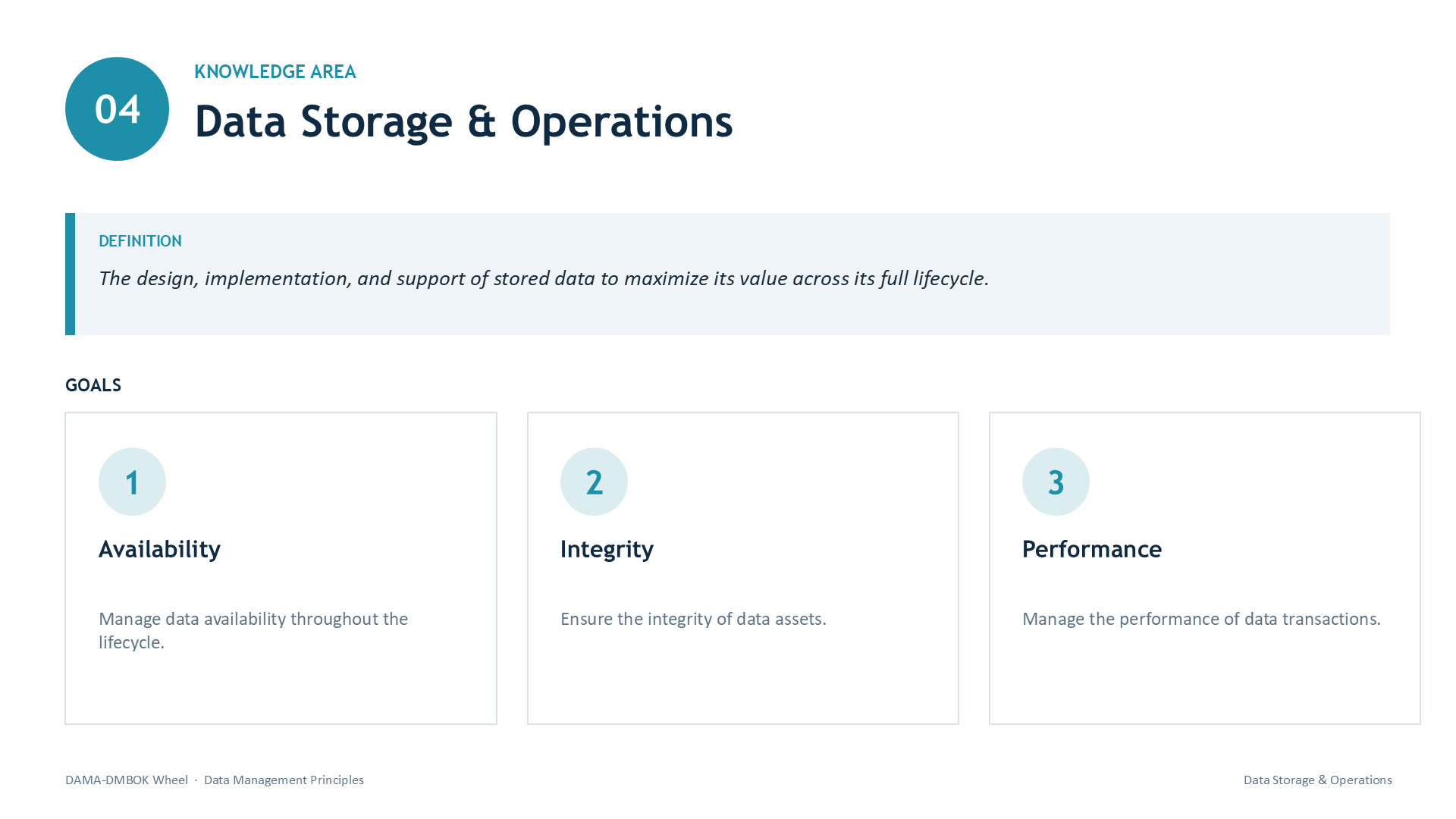
Slide 10: 04 | KNOWLEDGE AREA | Data Storage & Operations | DEFINITION | The design, implementation, and support of stored data to maximize its value across its full lifecycle. | GOALS | 1 | Availability | Manage data availability throughout the lifecycle. | 2 | Integrity | Ensure the integrity of data assets. | 3 | Performance | Manage the performance of data transactions.
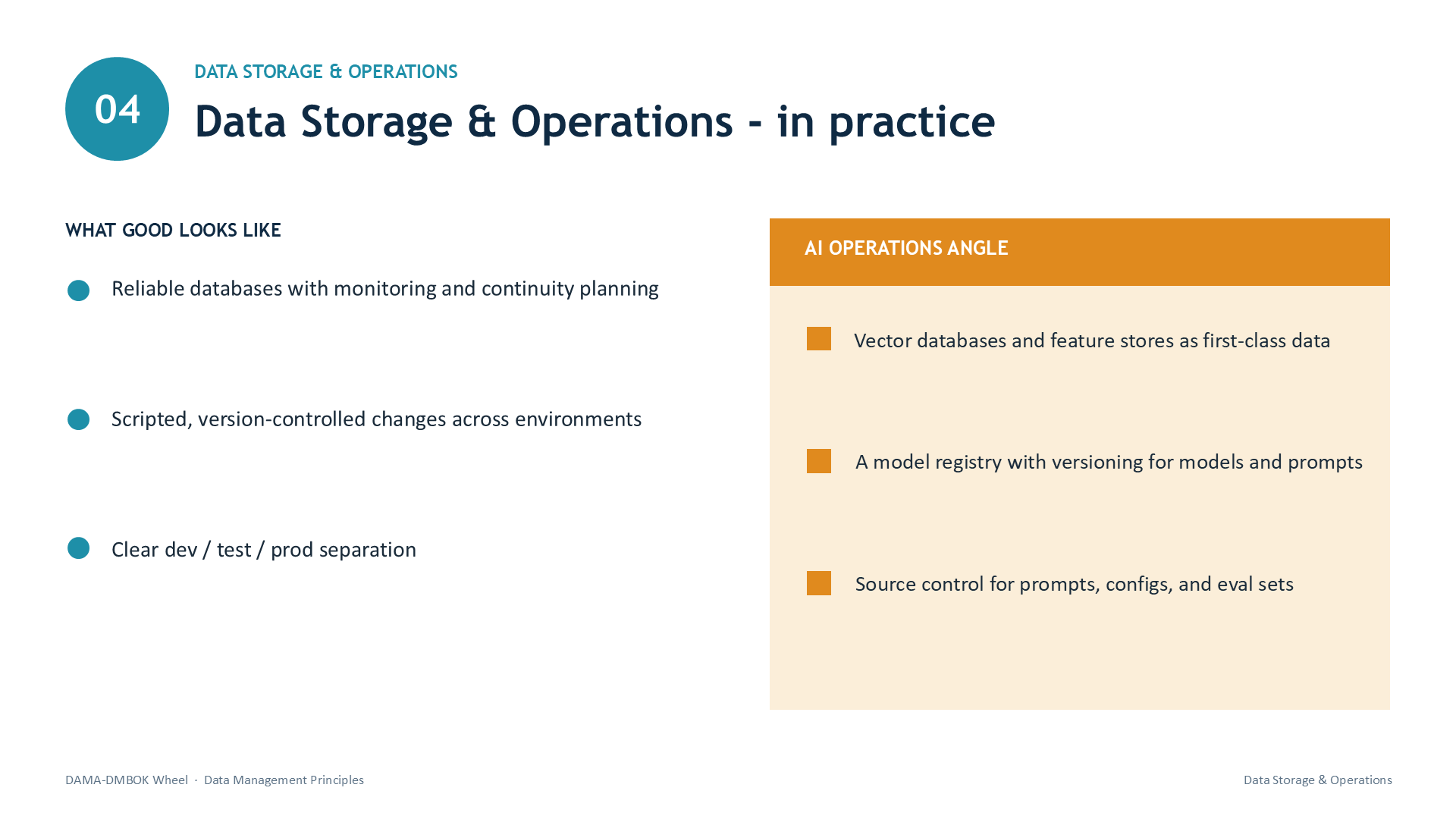
Slide 11: 04 | DATA STORAGE & OPERATIONS | Data Storage & Operations - in practice | WHAT GOOD LOOKS LIKE | Reliable databases with monitoring and continuity planning | Scripted, version-controlled changes across environments | Clear dev / test / prod separation | AI OPERATIONS ANGLE | Vector databases and feature stores as first-class data | A model registry with versioning for models and prompts | Source control for prompts, configs, and eval sets
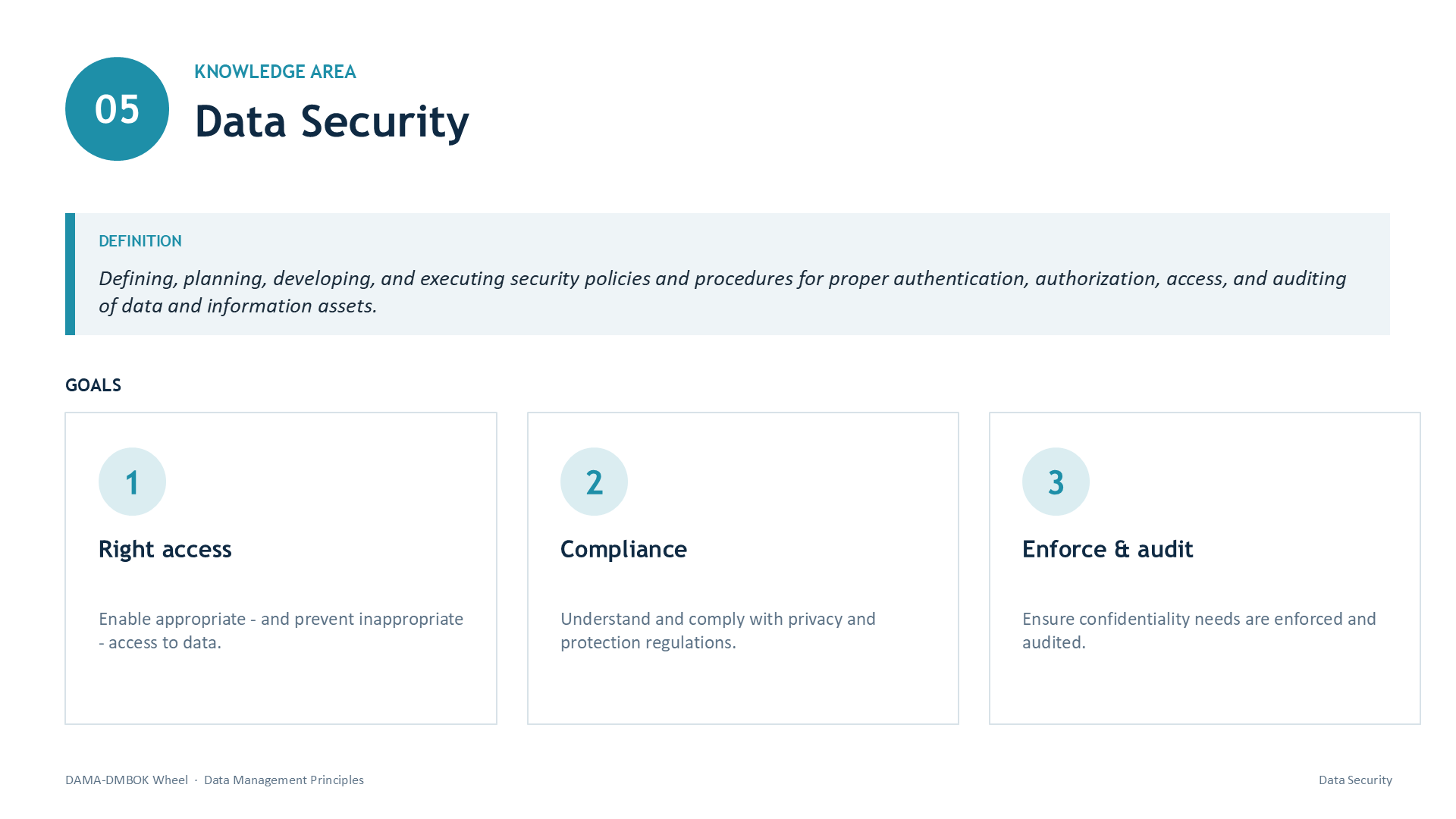
Slide 12: 05 | KNOWLEDGE AREA | Data Security | DEFINITION | Defining, planning, developing, and executing security policies and procedures for proper authentication, authorization, access, and auditing of data and information assets. | GOALS | 1 | Right access | Enable appropriate - and prevent inappropriate - access to data. | 2 | Compliance | Understand and comply with privacy and protection regulations. | 3 | Enforce & audit | Ensure confidentiality needs are enforced and audited.
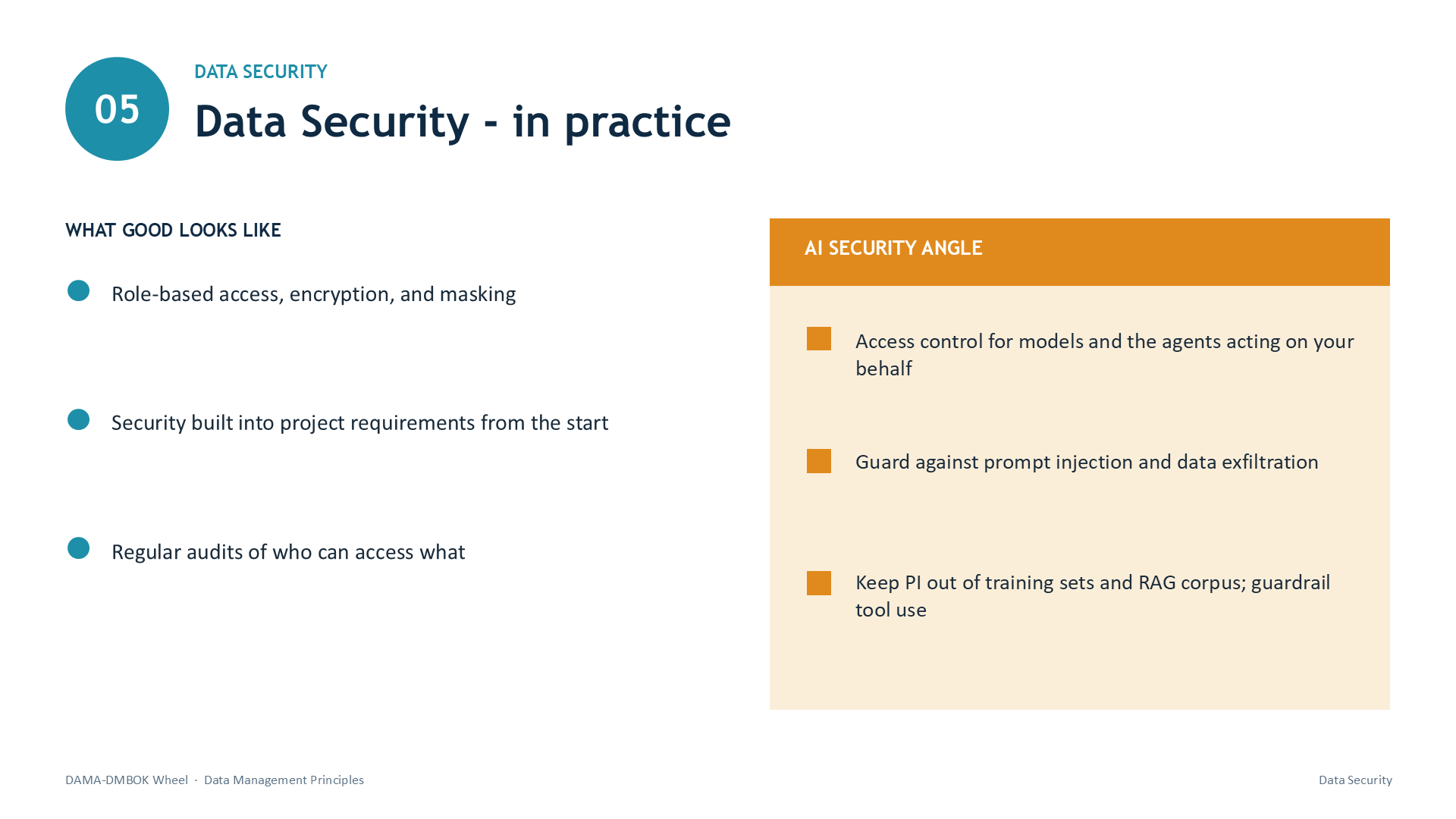
Slide 13: 05 | DATA SECURITY | Data Security - in practice | WHAT GOOD LOOKS LIKE | Role-based access, encryption, and masking | Security built into project requirements from the start | Regular audits of who can access what | AI SECURITY ANGLE | Access control for models and the agents acting on your behalf | Guard against prompt injection and data exfiltration | Keep PI out of training sets and RAG corpus; guardrail tool use
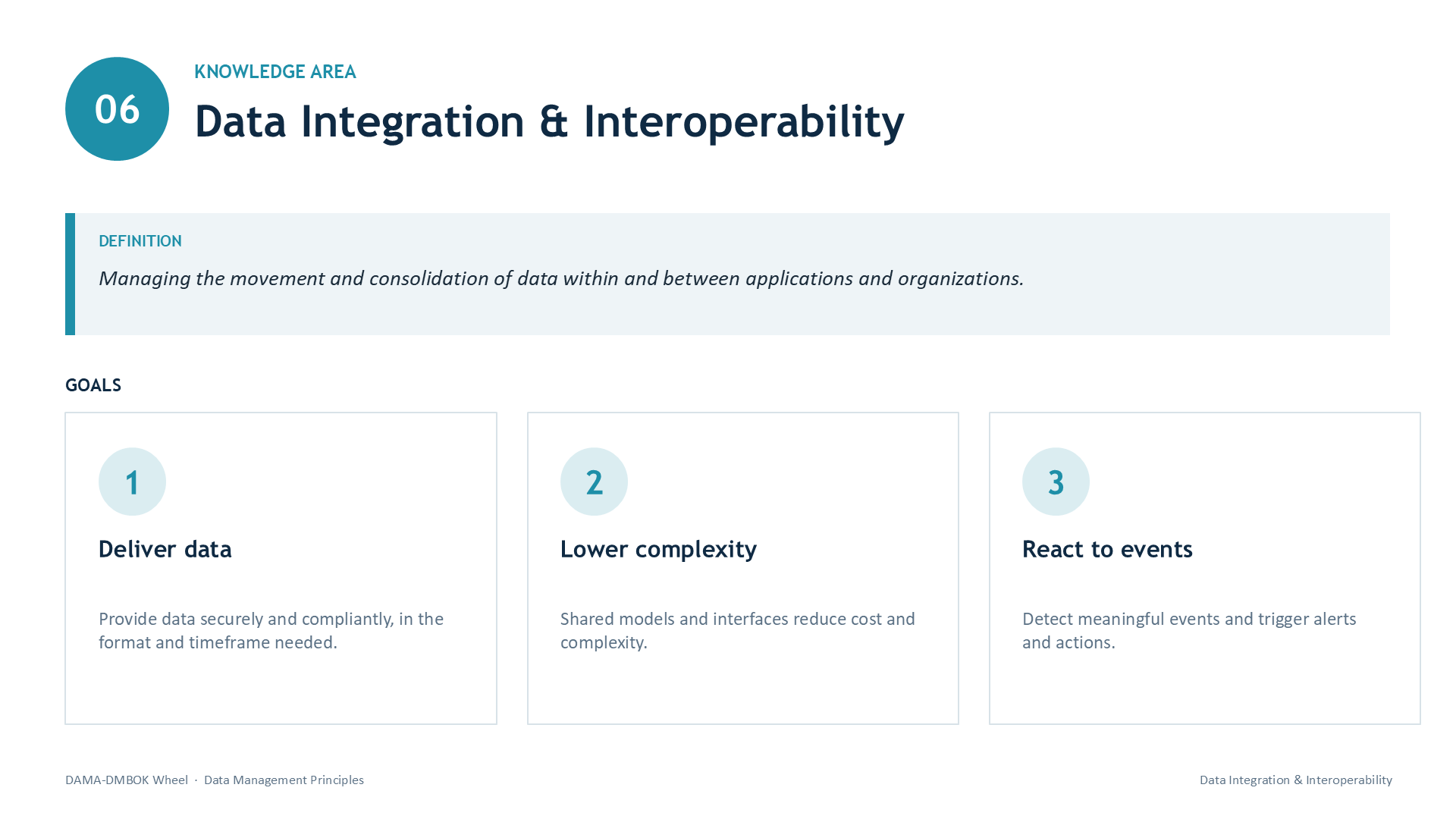
Slide 14: 06 | KNOWLEDGE AREA | Data Integration & Interoperability | DEFINITION | Managing the movement and consolidation of data within and between applications and organizations. | GOALS | 1 | Deliver data | Provide data securely and compliantly, in the format and timeframe needed. | 2 | Lower complexity | Shared models and interfaces reduce cost and complexity. | 3 | React to events | Detect meaningful events and trigger alerts and actions.
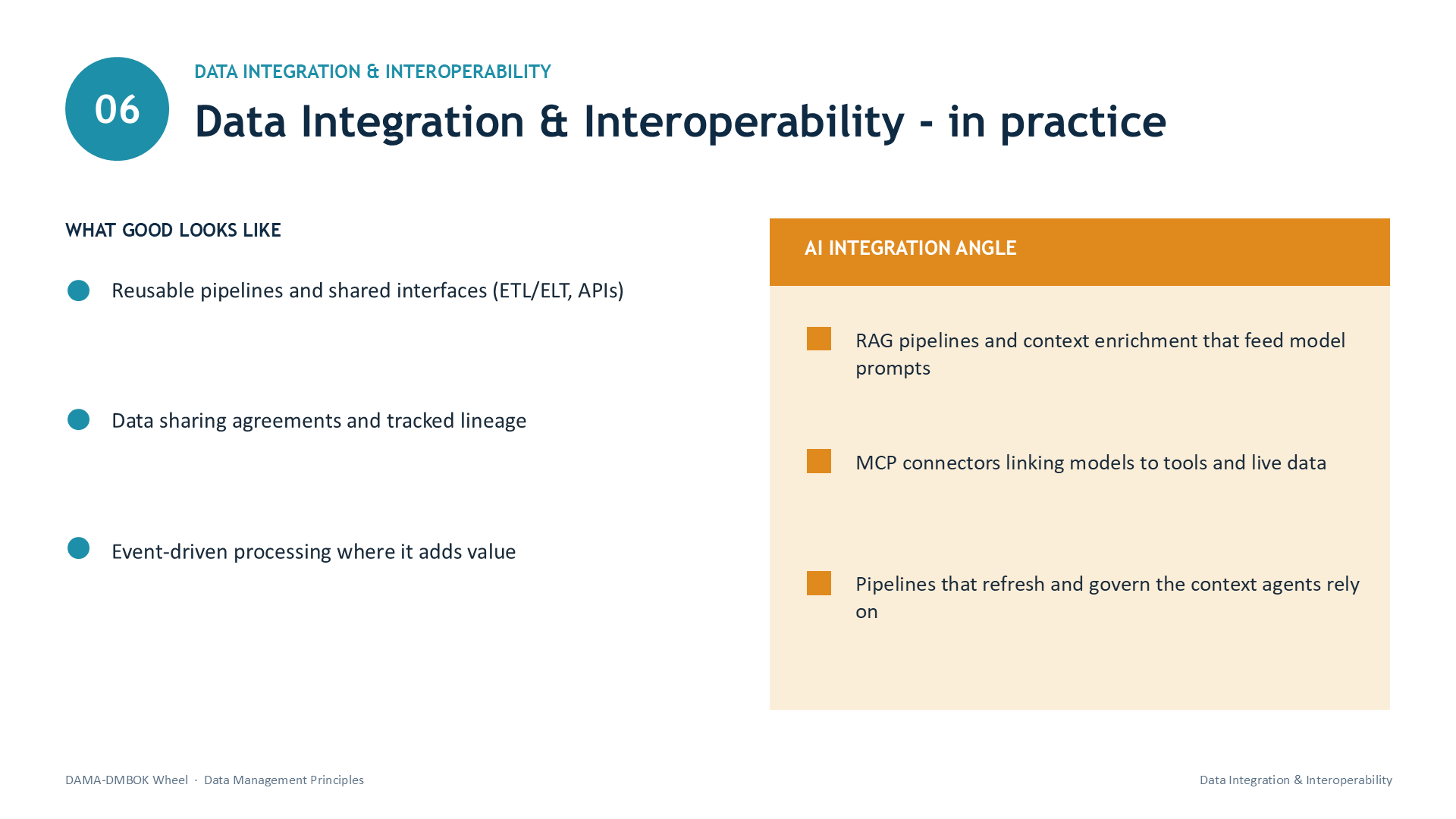
Slide 15: 06 | DATA INTEGRATION & INTEROPERABILITY | Data Integration & Interoperability - in practice | WHAT GOOD LOOKS LIKE | Reusable pipelines and shared interfaces (ETL/ELT, APIs) | Data sharing agreements and tracked lineage | Event-driven processing where it adds value | AI INTEGRATION ANGLE | RAG pipelines and context enrichment that feed model prompts | MCP connectors linking models to tools and live data | Pipelines that refresh and govern the context agents rely on
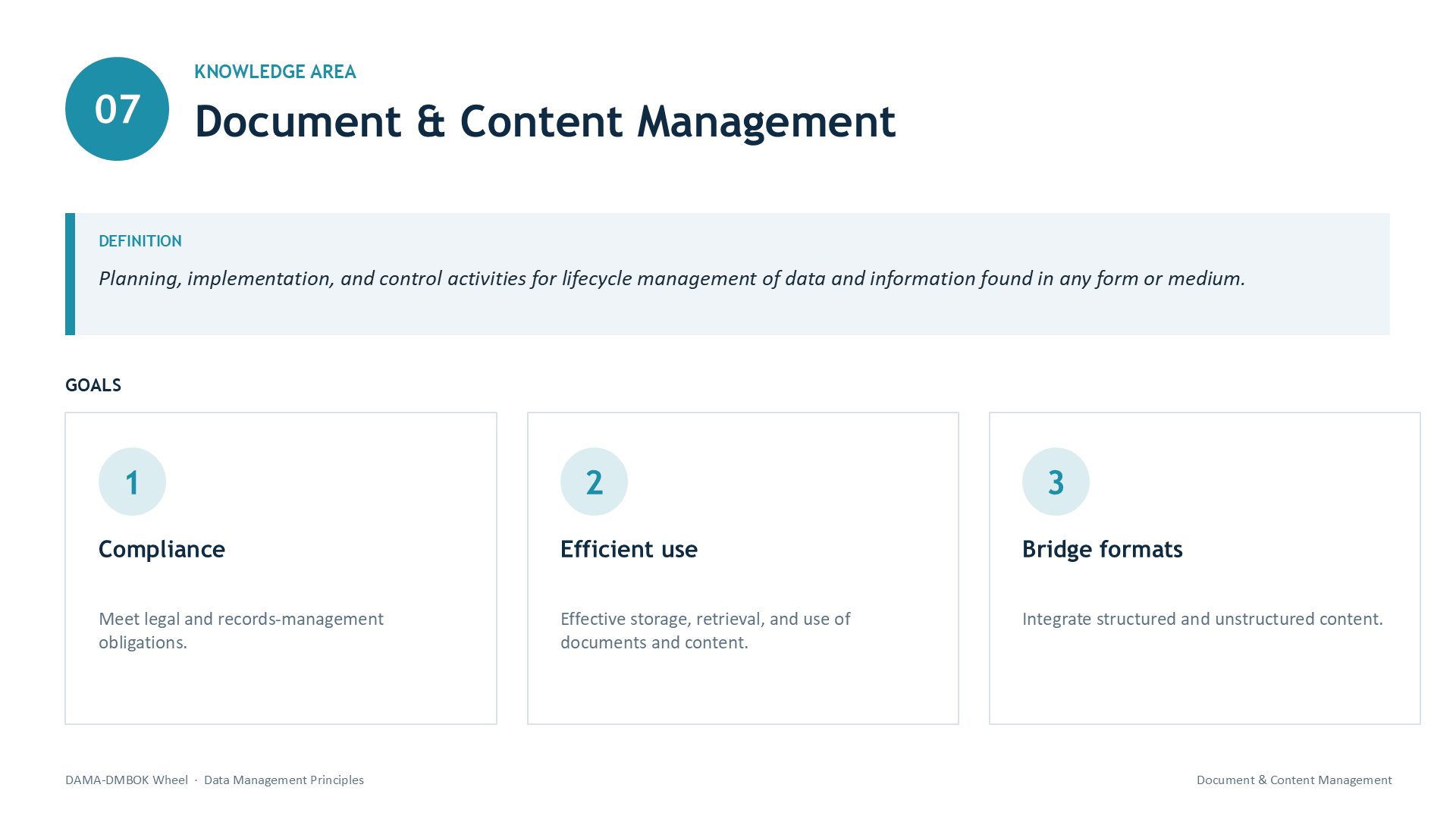
Slide 16: 07 | KNOWLEDGE AREA | Document & Content Management | DEFINITION | Planning, implementation, and control activities for lifecycle management of data and information found in any form or medium. | GOALS | 1 | Compliance | Meet legal and records-management obligations. | 2 | Efficient use | Effective storage, retrieval, and use of documents and content. | 3 | Bridge formats | Integrate structured and unstructured content.
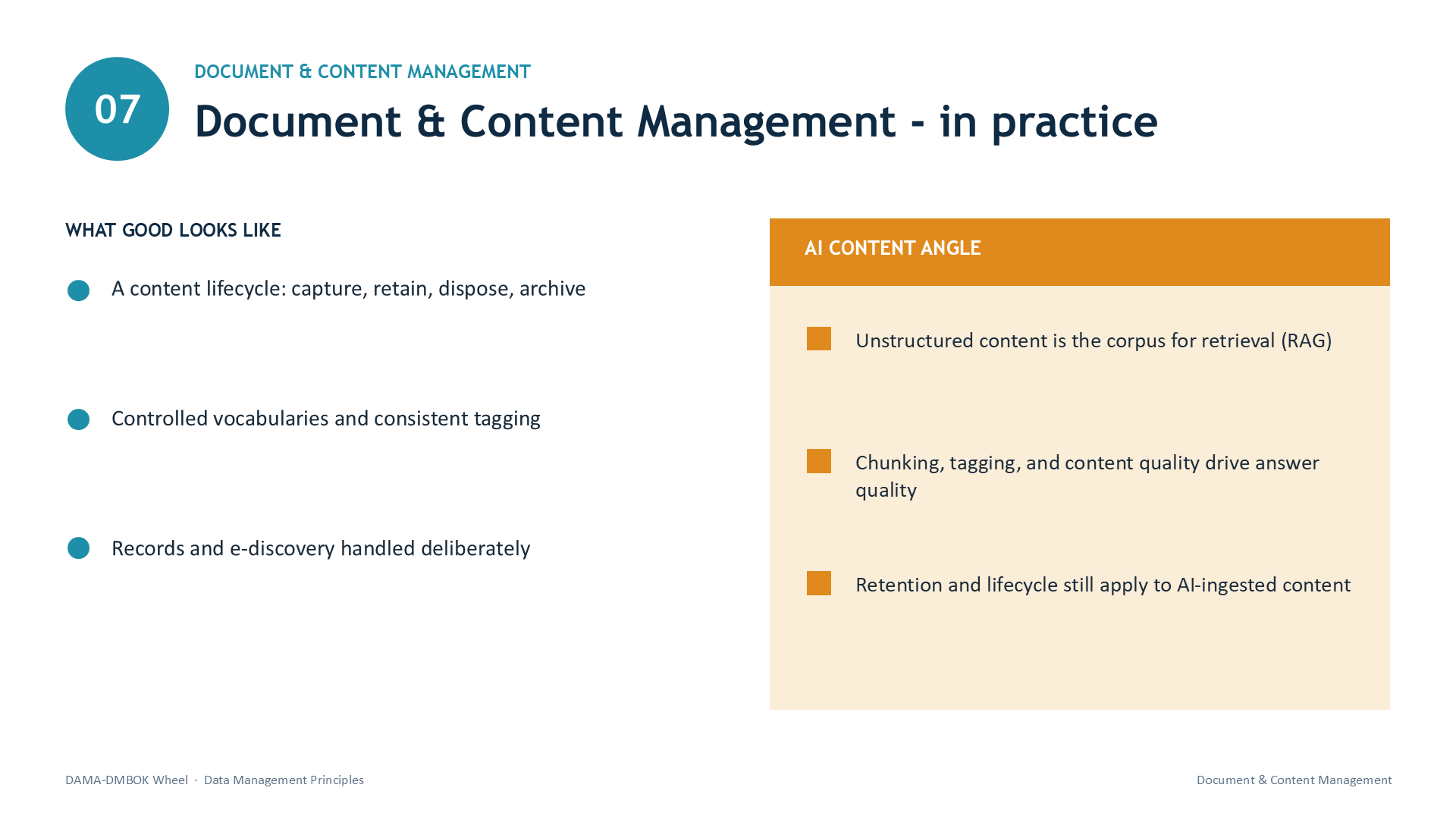
Slide 17: 07 | DOCUMENT & CONTENT MANAGEMENT | Document & Content Management - in practice | WHAT GOOD LOOKS LIKE | A content lifecycle: capture, retain, dispose, archive | Controlled vocabularies and consistent tagging | Records and e-discovery handled deliberately | AI CONTENT ANGLE | Unstructured content is the corpus for retrieval (RAG) | Chunking, tagging, and content quality drive answer quality | Retention and lifecycle still apply to AI-ingested content
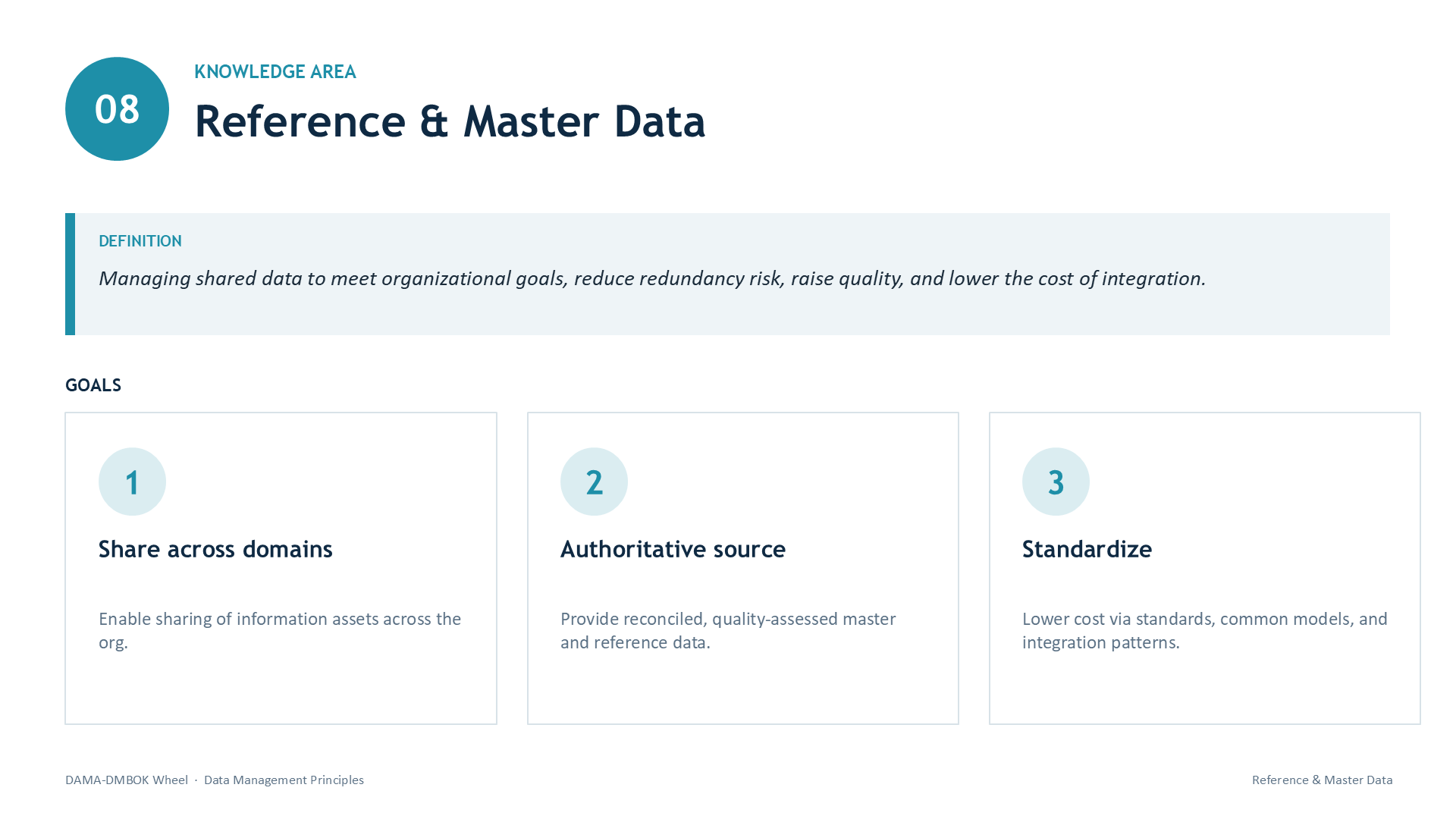
Slide 18: 08 | KNOWLEDGE AREA | Reference & Master Data | DEFINITION | Managing shared data to meet organizational goals, reduce redundancy risk, raise quality, and lower the cost of integration. | GOALS | 1 | Share across domains | Enable sharing of information assets across the org. | 2 | Authoritative source | Provide reconciled, quality-assessed master and reference data. | 3 | Standardize | Lower cost via standards, common models, and integration patterns.
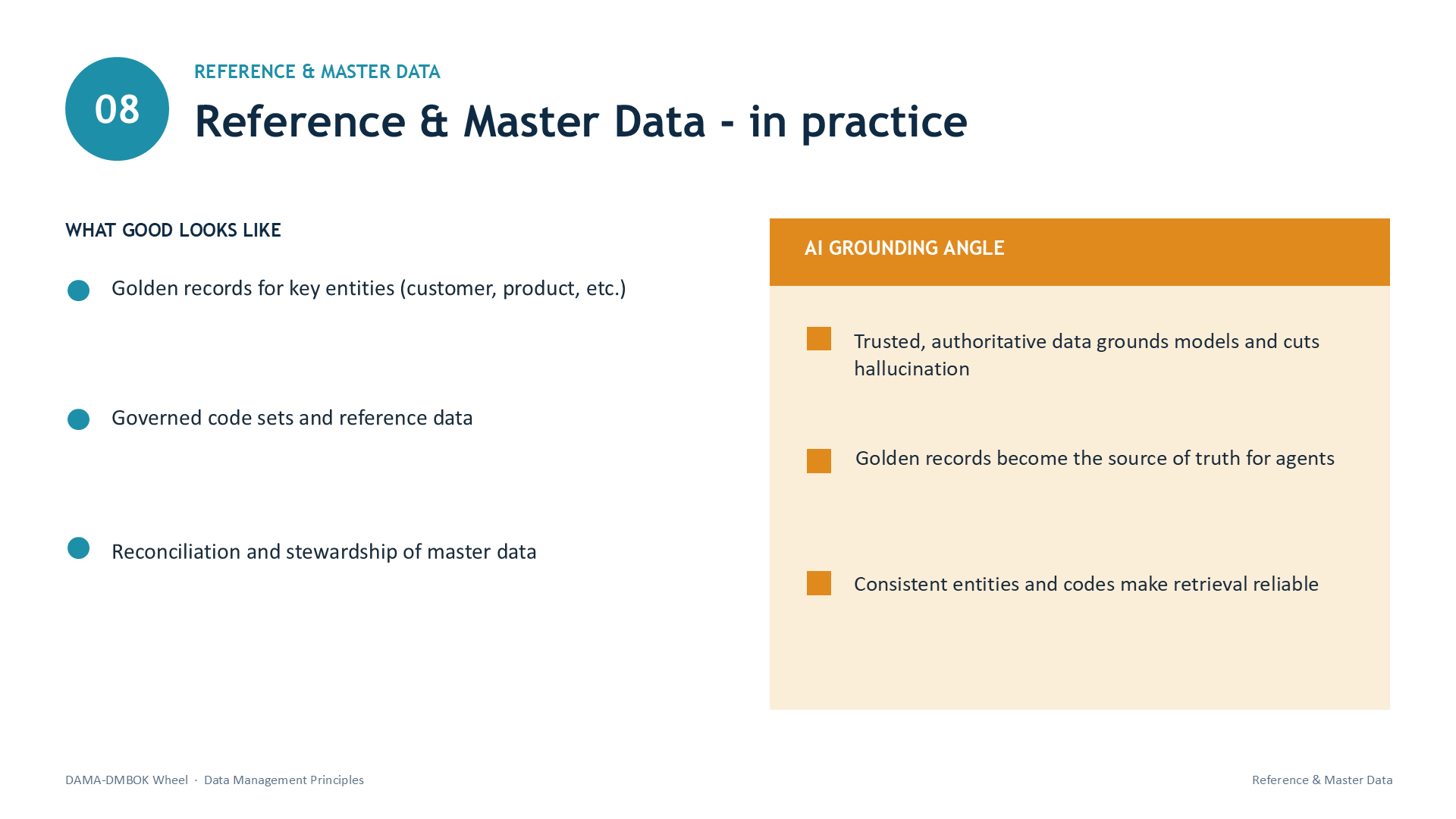
Slide 19: 08 | REFERENCE & MASTER DATA | Reference & Master Data - in practice | WHAT GOOD LOOKS LIKE | Golden records for key entities (customer, product, etc.) | Governed code sets and reference data | Reconciliation and stewardship of master data | AI GROUNDING ANGLE | Trusted, authoritative data grounds models and cuts hallucination | Golden records become the source of truth for agents | Consistent entities and codes make retrieval reliable
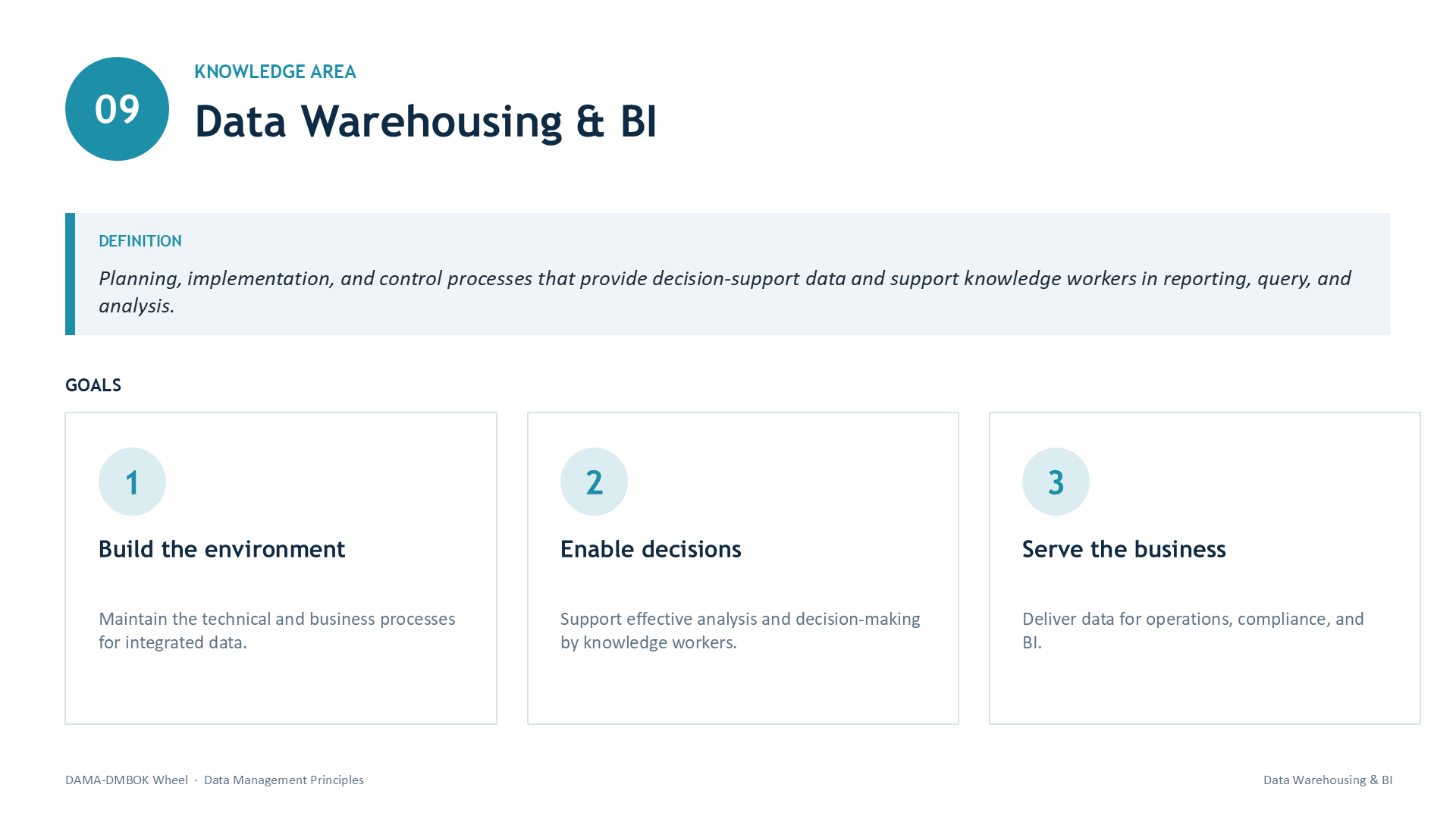
Slide 20: 09 | KNOWLEDGE AREA | Data Warehousing & BI | DEFINITION | Planning, implementation, and control processes that provide decision-support data and support knowledge workers in reporting, query, and analysis. | GOALS | 1 | Build the environment | Maintain the technical and business processes for integrated data. | 2 | Enable decisions | Support effective analysis and decision-making by knowledge workers. | 3 | Serve the business | Deliver data for operations, compliance, and BI.
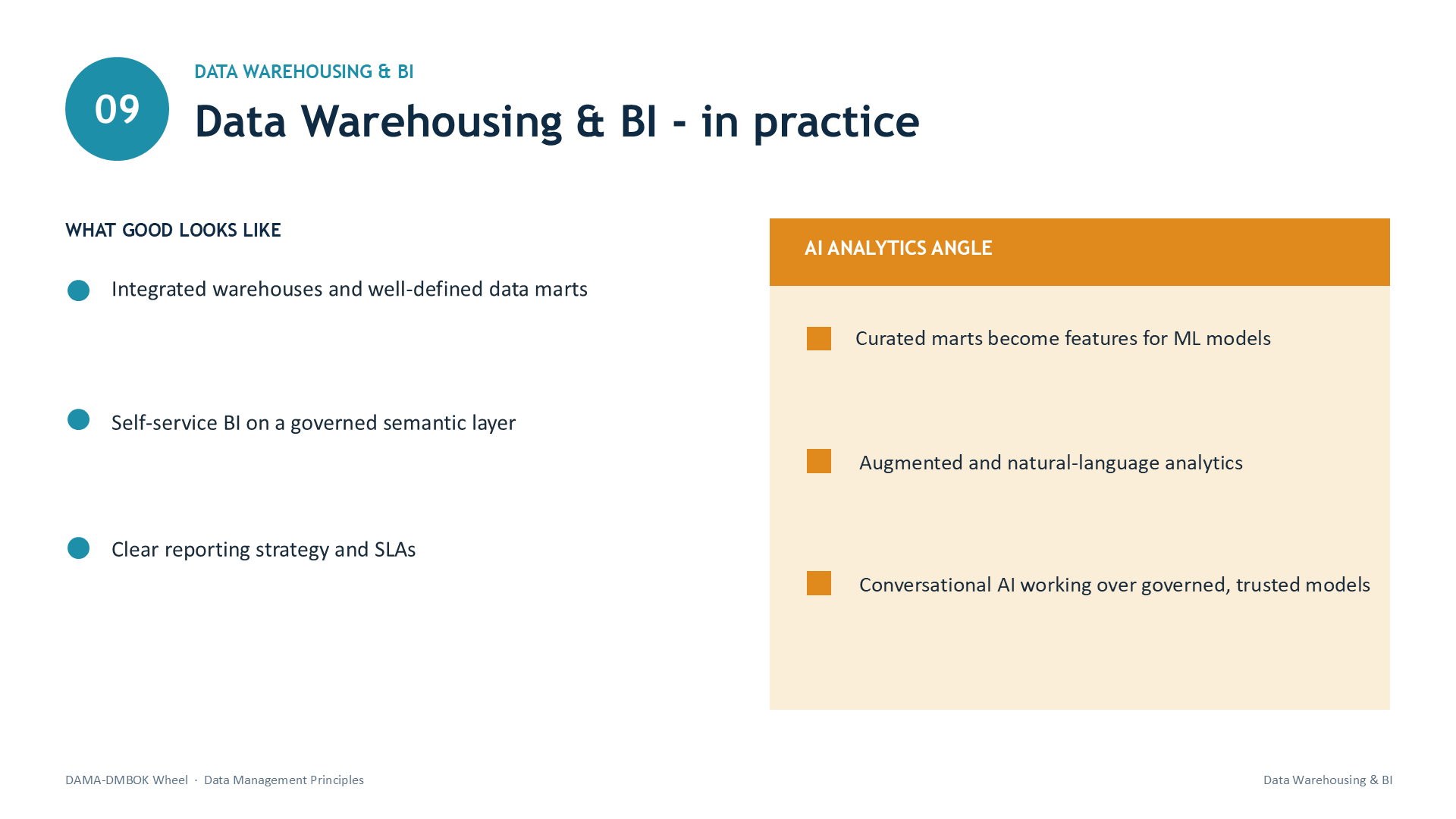
Slide 21: 09 | DATA WAREHOUSING & BI | Data Warehousing & BI - in practice | WHAT GOOD LOOKS LIKE | Integrated warehouses and well-defined data marts | Self-service BI on a governed semantic layer | Clear reporting strategy and SLAs | AI ANALYTICS ANGLE | Curated marts become features for ML models | Augmented and natural-language analytics | Conversational AI working over governed, trusted models
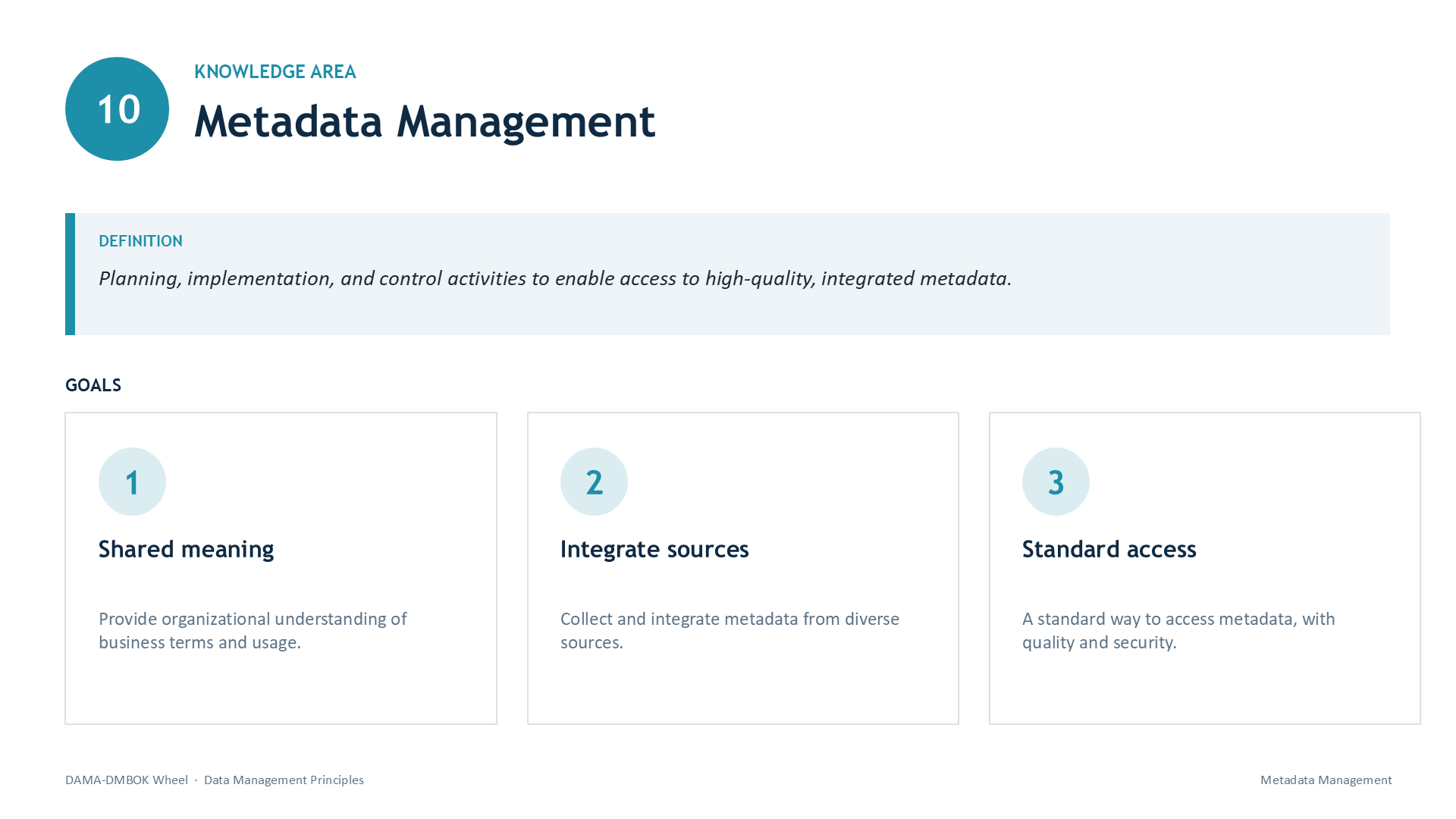
Slide 22: 10 | KNOWLEDGE AREA | Metadata Management | DEFINITION | Planning, implementation, and control activities to enable access to high-quality, integrated metadata. | GOALS | 1 | Shared meaning | Provide organizational understanding of business terms and usage. | 2 | Integrate sources | Collect and integrate metadata from diverse sources. | 3 | Standard access | A standard way to access metadata, with quality and security.
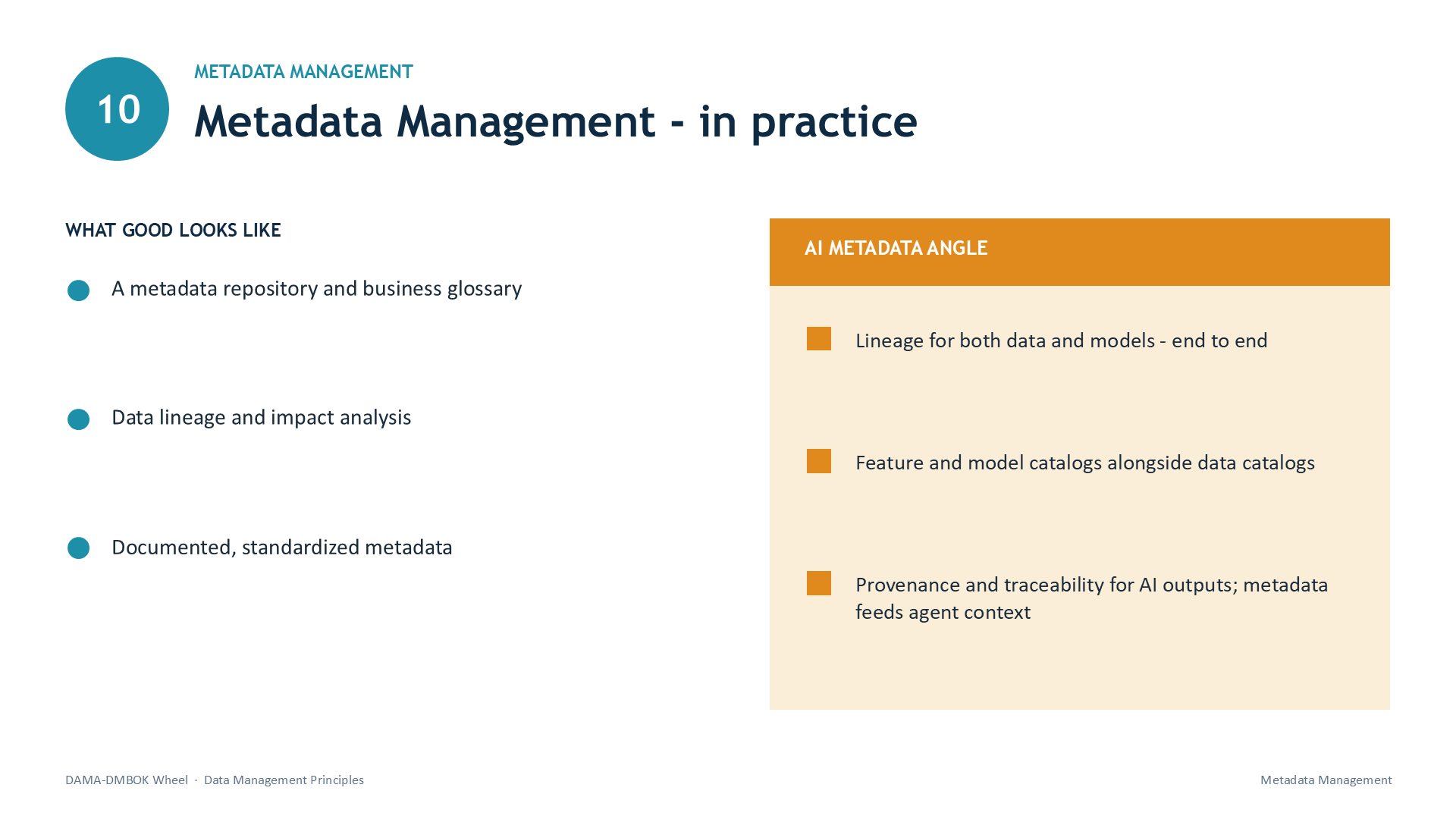
Slide 23: 10 | METADATA MANAGEMENT | Metadata Management - in practice | WHAT GOOD LOOKS LIKE | A metadata repository and business glossary | Data lineage and impact analysis | Documented, standardized metadata | AI METADATA ANGLE | Lineage for both data and models - end to end | Feature and model catalogs alongside data catalogs | Provenance and traceability for AI outputs; metadata feeds agent context
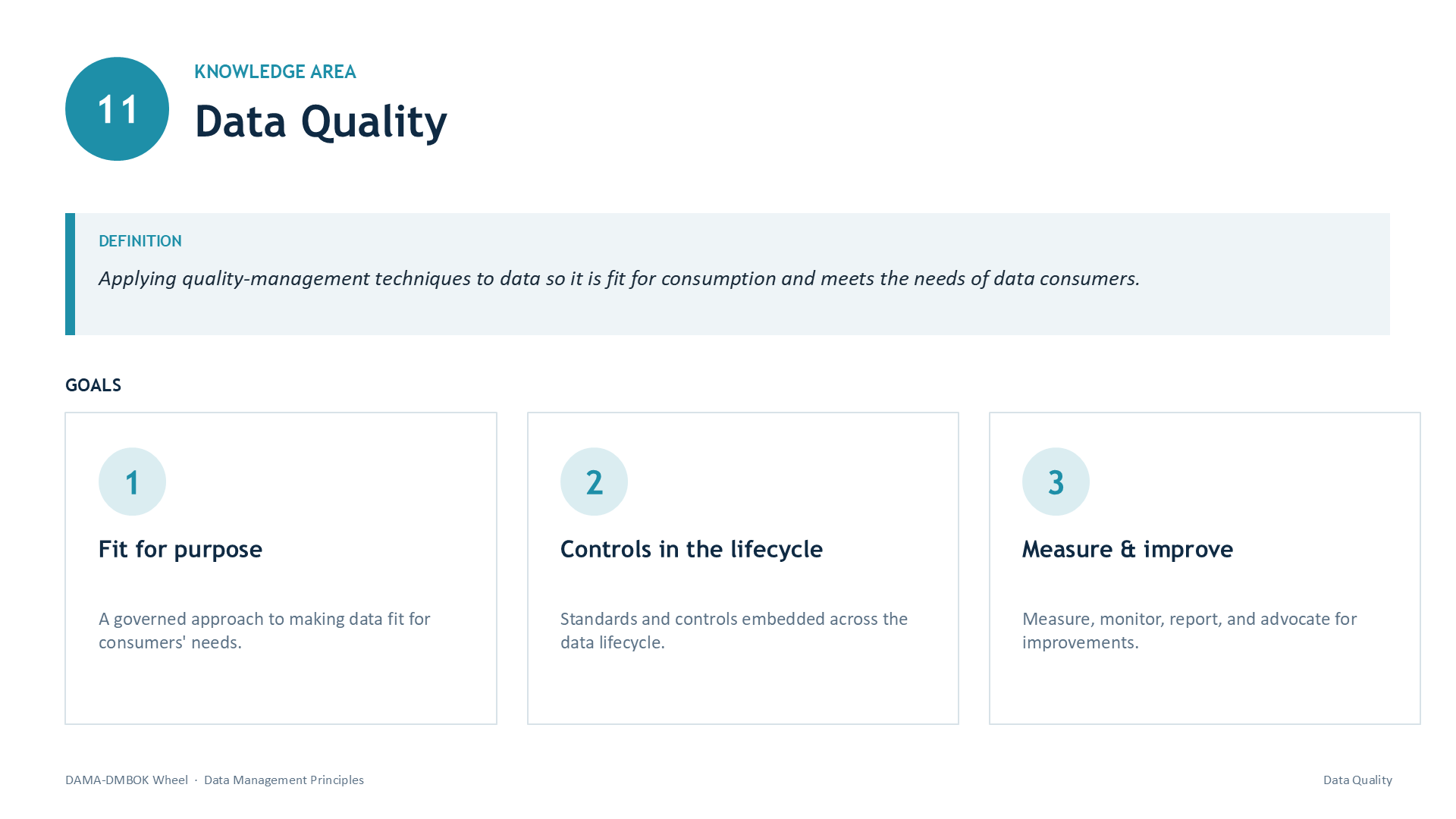
Slide 24: 11 | KNOWLEDGE AREA | Data Quality | DEFINITION | Applying quality-management techniques to data so it is fit for consumption and meets the needs of data consumers. | GOALS | 1 | Fit for purpose | A governed approach to making data fit for consumers' needs. | 2 | Controls in the lifecycle | Standards and controls embedded across the data lifecycle. | 3 | Measure & improve | Measure, monitor, report, and advocate for improvements.
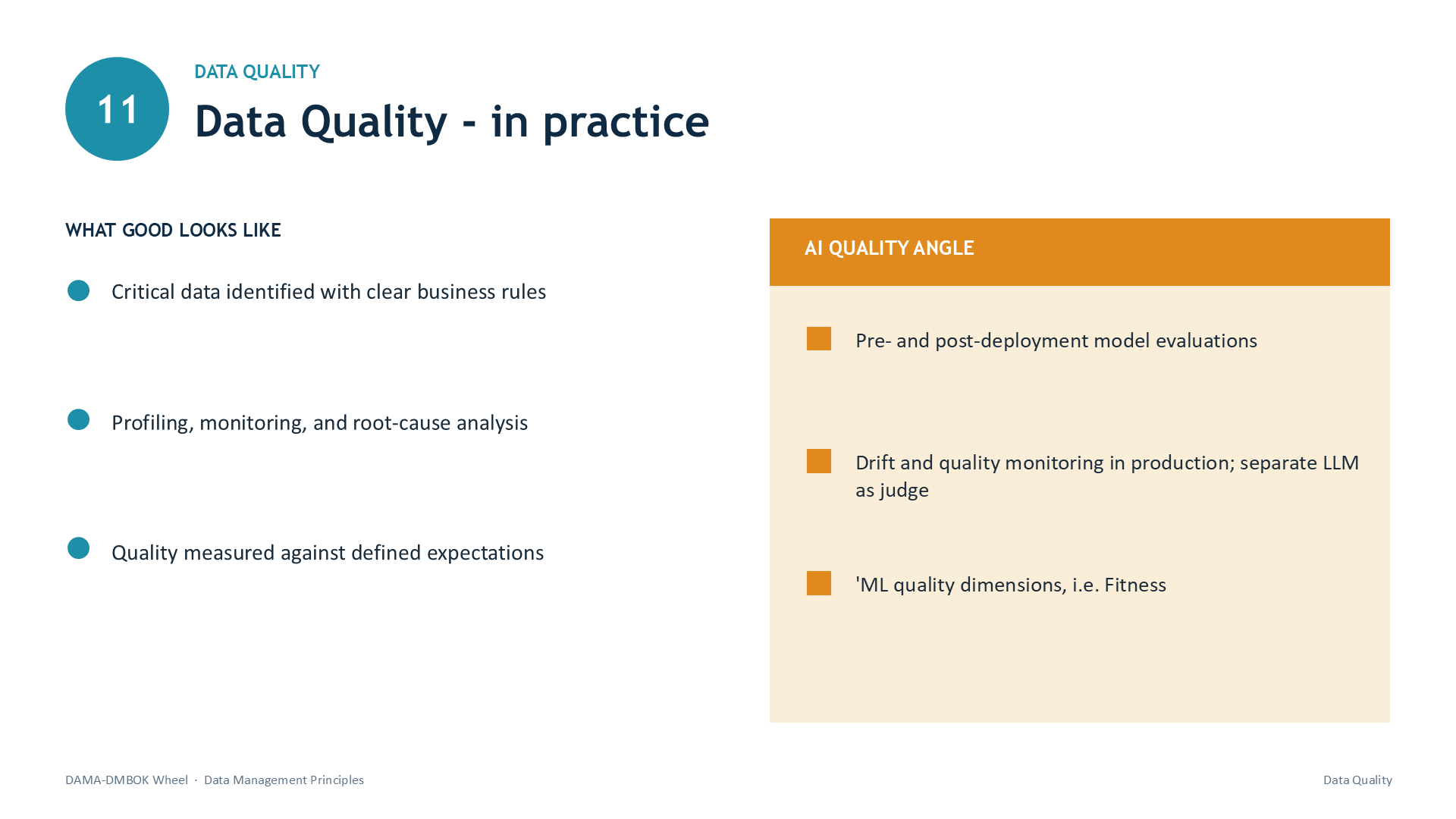
Slide 25: 11 | DATA QUALITY | Data Quality - in practice | WHAT GOOD LOOKS LIKE | Critical data identified with clear business rules | Profiling, monitoring, and root-cause analysis | Quality measured against defined expectations | AI QUALITY ANGLE | Pre- and post-deployment model evaluations | Drift and quality monitoring in production; separate LLM as judge | ML quality dimensions, i.e. Fitness
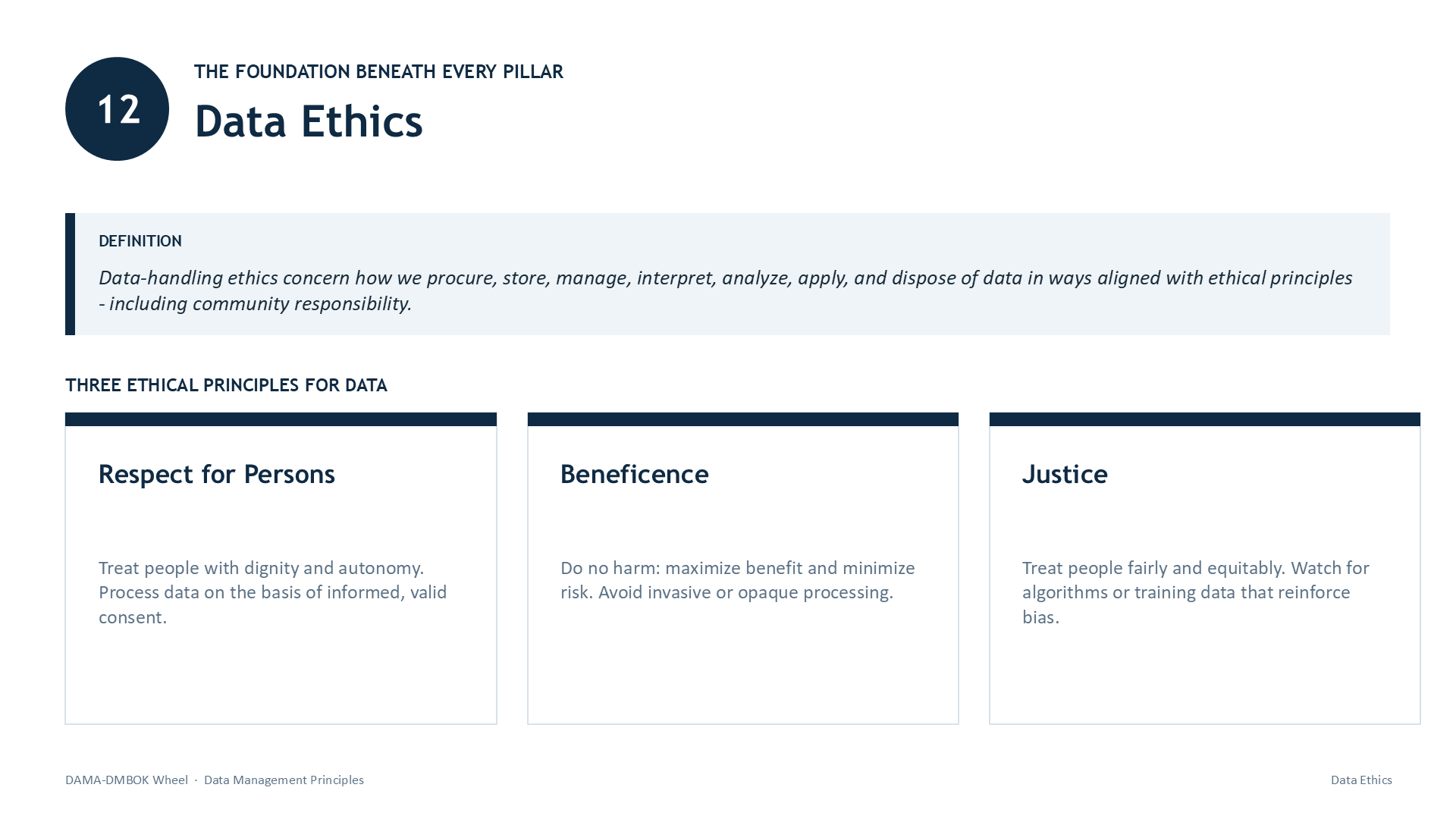
Slide 26: 12 | THE FOUNDATION BENEATH EVERY PILLAR | Data Ethics | DEFINITION | Data-handling ethics concern how we procure, store, manage, interpret, analyze, apply, and dispose of data in ways aligned with ethical principles - including community responsibility. | THREE ETHICAL PRINCIPLES FOR DATA | Respect for Persons | Treat people with dignity and autonomy. Process data on the basis of informed, valid consent. | Beneficence | Do no harm: maximize benefit and minimize risk. Avoid invasive or opaque processing. | Justice | Treat people fairly and equitably. Watch for algorithms or training data that reinforce bias.
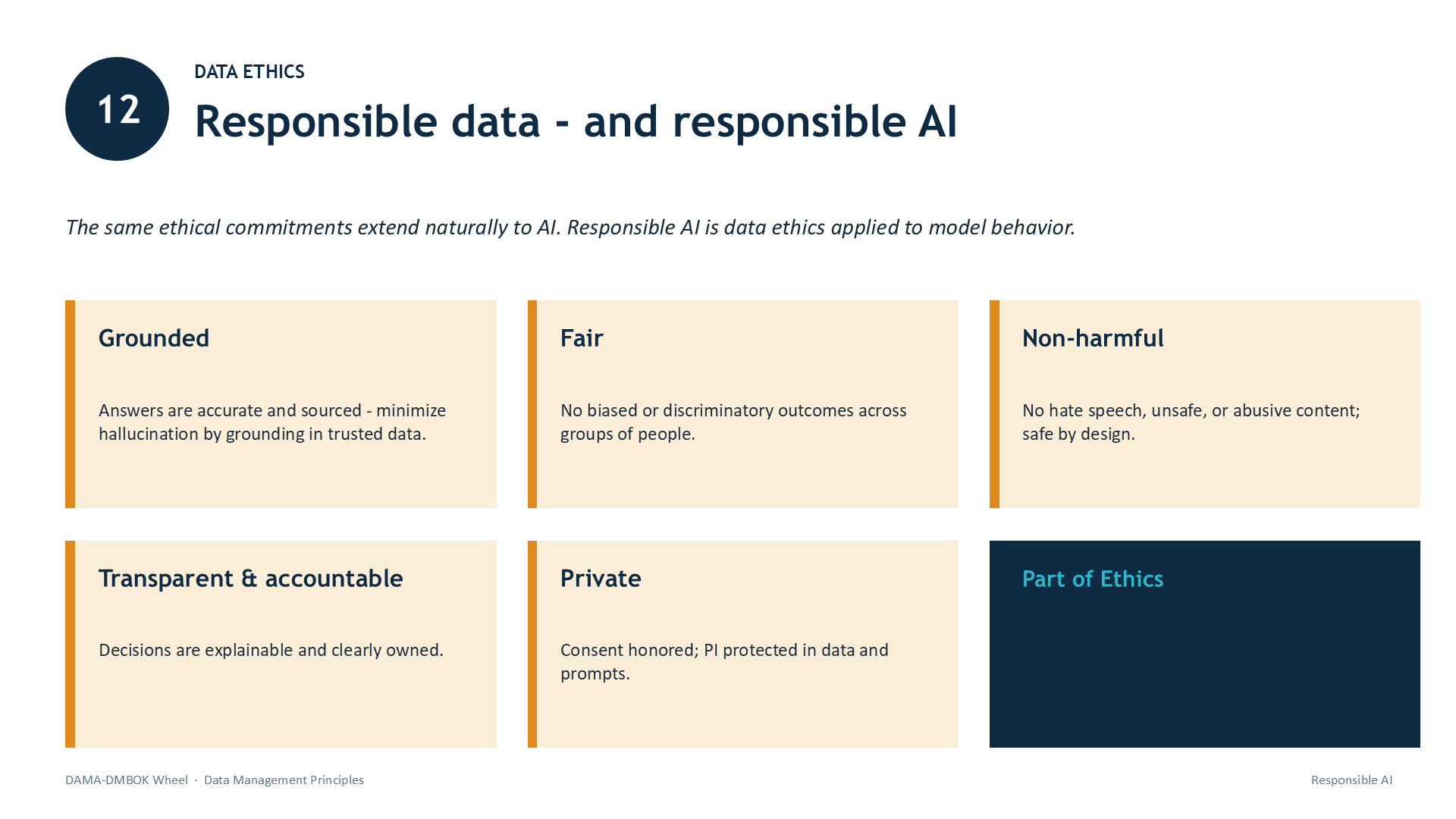
Slide 27: 12 | DATA ETHICS | Responsible data - and responsible AI | The same ethical commitments extend naturally to AI. Responsible AI is data ethics applied to model behavior. | Grounded | Answers are accurate and sourced - minimize hallucination by grounding in trusted data. | Fair | No biased or discriminatory outcomes across groups of people. | Non-harmful | No hate speech, unsafe, or abusive content; safe by design. | Transparent & accountable | Decisions are explainable and clearly owned. | Private | Consent honored; PI protected in data and prompts. | Part of Ethics
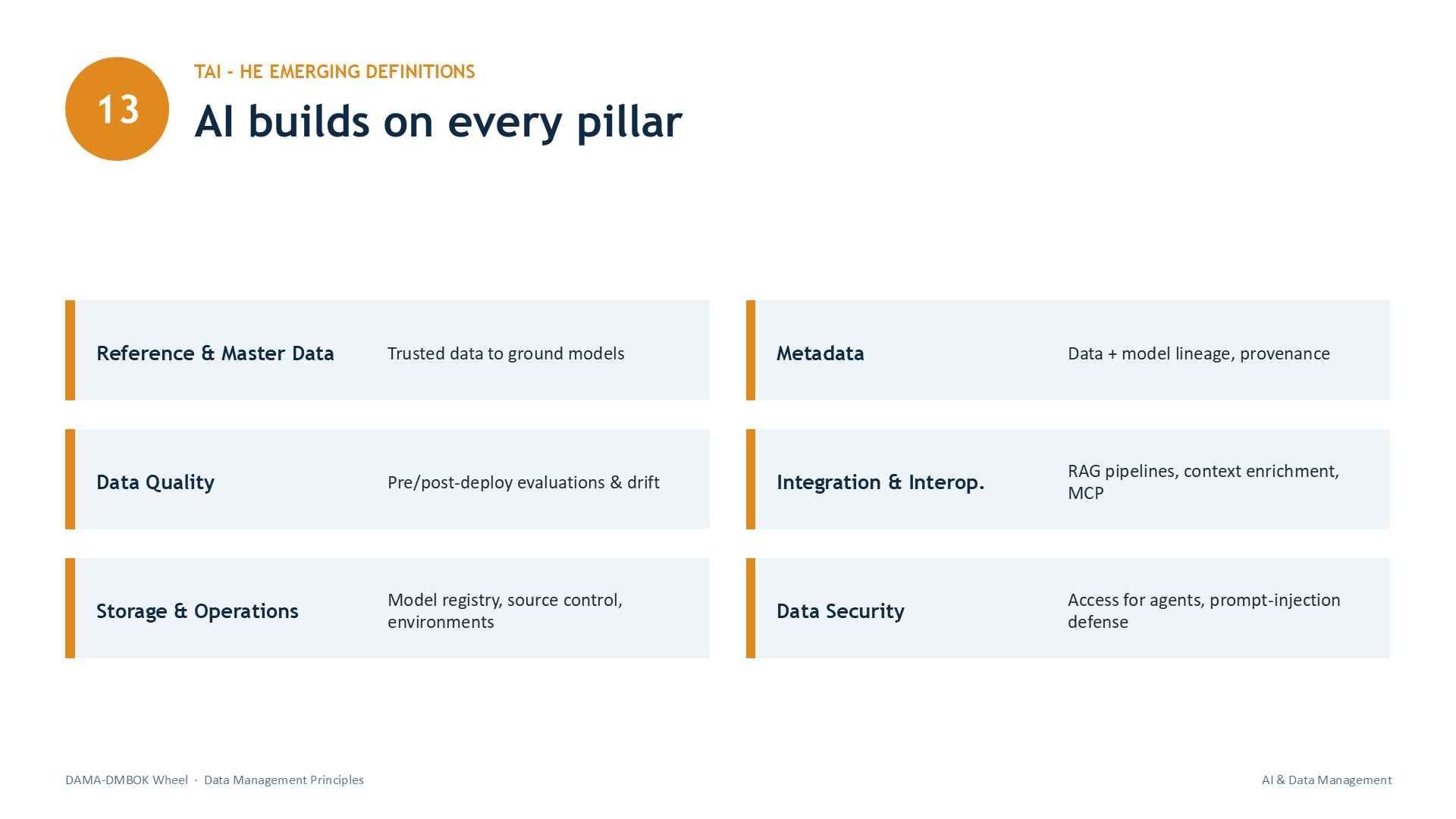
Slide 28: 13 | AI - THE EMERGING DEFINITIONS | AI builds on every pillar | Reference & Master Data | Trusted data to ground models | Metadata | Data + model lineage, provenance | Data Quality | Pre/post-deploy evaluations & drift | Integration & Interop. | RAG pipelines, context enrichment, MCP | Storage & Operations | Model registry, source control, environments | Data Security | Access for agents, prompt-injection defense
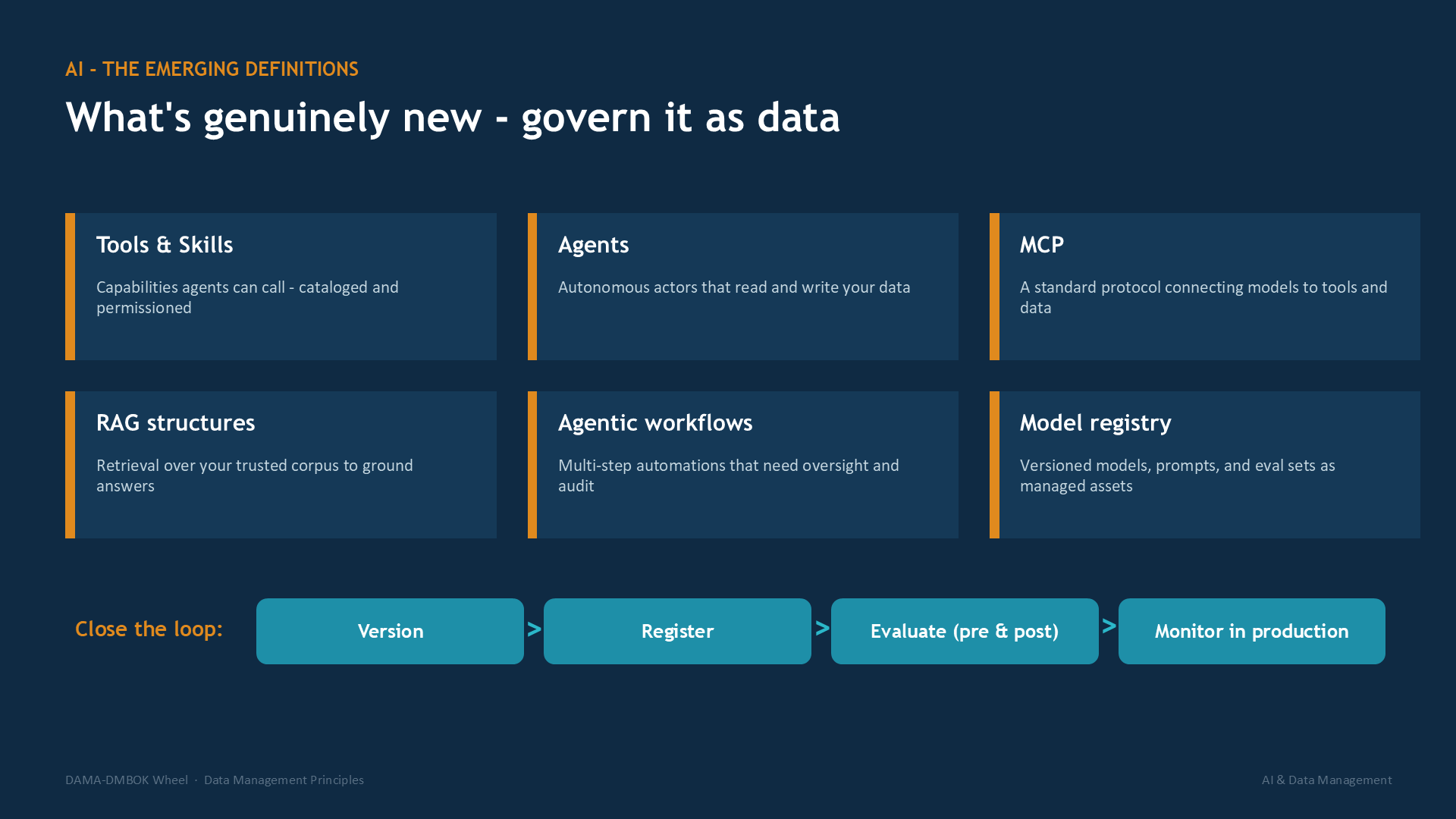
Slide 29: AI - THE EMERGING DEFINITIONS | What's genuinely new - govern it as data | Tools & Skills | Capabilities agents can call - cataloged and permissioned | Agents | Autonomous actors that read and write your data | MCP | A standard protocol connecting models to tools and data | RAG structures | Retrieval over your trusted corpus to ground answers | Agentic workflows | Multi-step automations that need oversight and audit | Model registry | Versioned models, prompts, and eval sets as managed assets | Close the loop: | Version | > | Register | > | Evaluate (pre & post) | > | Monitor in production
1 / 29

0 Comments

Leave a Comment